Where Learning Takes Root: Young Catholics in Kampala Turn Green Skills into Action
Posted August 21, 2026
In one photograph from the day, a crowd of young people in matching green shirts stands almost swallowed by the forest. Leaves press in from every direction. Phones are raised above broad-brimmed hats as a guide gestures toward something just beyond the frame. In another image, the same group is bent close to the earth, hands working around small black planting bags.
The photographs tell something important about the Kampala Archdiocese Youth Apostolate’s Ecotourism and Greenskilling Tour: this was not simply a day for talking about ecological crisis. It was a day for touching possible responses.
On July 11, 2026, 85 participants representing 40 parishes traveled to Bethany Land Institute (BLI) for a day of practical formation in integral ecology. Laudato Si’ Movement members and Focolare youths were among those taking part. Bethany Land Institute may already be familiar to Laudato Si’ Action Platform readers: last year, we featured its work and distinctive approach to integral ecology. This visit, sponsored by Centenary Foundation, introduced participants to organic farming, regenerative agroforestry, forest ecology, tree breeding and other green skills.
Read our earlier story on Bethany Land Institute
For Fr. Joseph Mary Ssebunnya, Director of the Kampala Archdiocese Youth Apostolate, the urgency behind the experience is increasingly difficult to separate from ordinary life.
“The environment is all about you and me regardless of age, gender, origin, or academic or socio-economic standard,” he said. “We are obliged to take Pope Francis’ message in the famous Encyclical Laudato Si’ more serious than before.”
That conviction helped inspire the Kampala Archdiocese Youth Apostolate, developed with young people who, as Fr. Joseph put it, “realized the need to do something about Mother Nature in their own way.”
A living classroom
After leaving Kampala early in the morning, participants arrived at Bethany Land Institute around 9:15 a.m. Their classroom would be spread across three evocatively named spaces: Mary’s Farm, Martha’s Market and Lazarus Forest. There, BLI trainers introduced them to practices ranging from organic pesticides and mushroom growing to water retention, biogas, composting, herbal medicine, agroforestry and tree identification. The day also included forest hiking and a drama session exploring environmental advocacy.
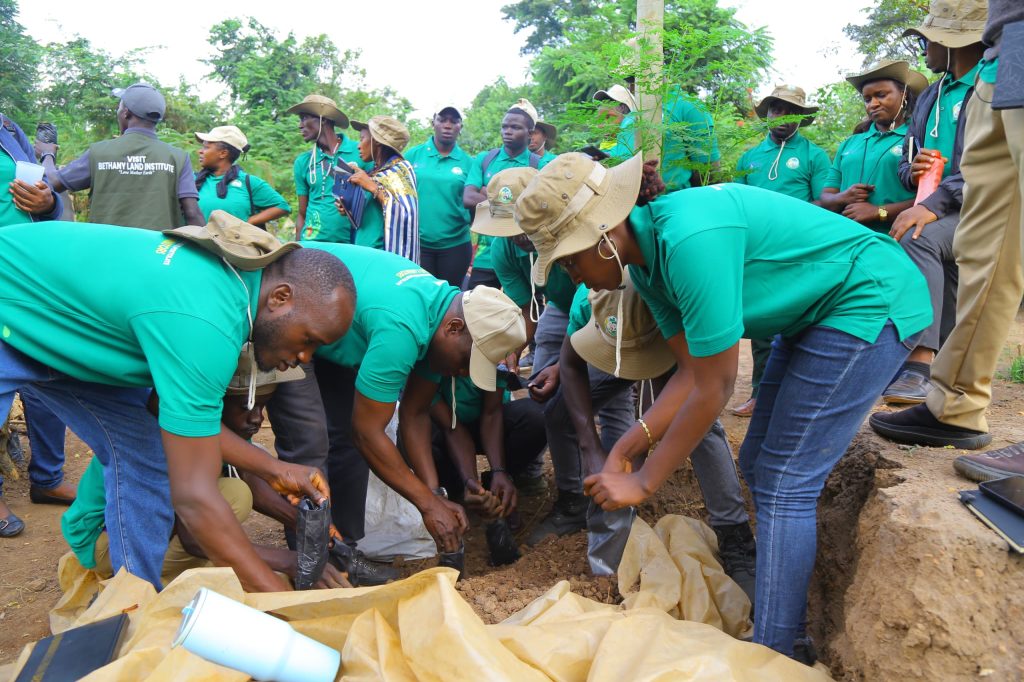
Some of the simplest practices made the deepest impression.
The preparation of liquid organic fertilizer particularly fascinated participants, in part because many had never watched it being made firsthand.
For Nakanwagi Irene of Mwerwerwe Parish, that discovery immediately became an idea for home. She plans to make the plant-based fertilizer in her own farming community, using it in her vegetable garden and potentially selling it to other young people.
“I got intrigued by the plant fertilizer making technique,” she said. “I will be making this plant tea back in my parish—a farming community—and sell to my community, my fellow youths, and also use it in my vegetable garden.”
That movement—from I learned this to I could do this—may be the most significant outcome of the tour.
BLI became what project coordinator Winnie Batte described as a “living practical classroom”: a place where environmental problems appeared alongside responses that felt achievable rather than abstract or overwhelming.
For another participant, Sseruyange Jimmy of Bujjuko Parish, the experience offered knowledge he could bring directly into an existing rural youth green hub. Nalukwago Josephine of Nansana Parish left imagining something new: advocating for a parish-based green hub where young people could learn similar practical skills.
And perhaps most visibly, some participants left carrying seedlings purchased at Bethany Land Institute—small, living reminders of what they intended to begin at home.
From a good experience to an ecological pathway
For Laudato Si’ Action Platform participants elsewhere in the world, Kampala’s experience offers a useful lesson: formation becomes more powerful when people can practice the future they are being invited to create.
A parish does not necessarily need a sophisticated environmental program before beginning. It might partner with a local farm, conservation organization, university or community garden. A diocesan youth ministry might organize an exposure visit around one locally relevant issue—water, food, waste, biodiversity or renewable energy—and then ask participants to return with one action they can reproduce.
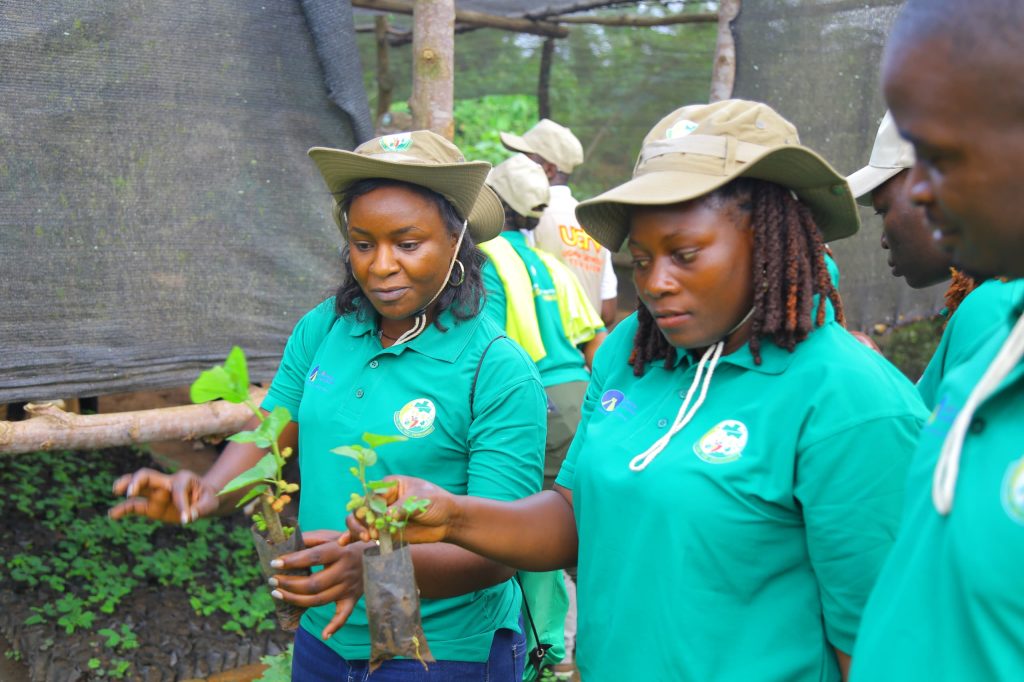
The Kampala team is also demonstrating another important principle: do not let the experience end when the bus ride home does.
The Youth Apostolate now plans to establish five model youth green hubs or incubator sites, follow at least ten implementation stories from participants, and organize further ecotourism and greenskilling sessions for deeper learning.
This turns a one-day event into something closer to an ecosystem: encounter, skill-building, experimentation, follow-up and sharing. Fr. Joseph believes the Church’s existing networks make that multiplication possible.
“When the youths are convinced and equipped with the relevant information, that message goes far not only geographically, but also across generation,” he said. And because parishes already hold deep community trust, “we are capable of making meaningful climate action.”
At Bethany Land Institute, that possibility looked very ordinary: people listening under trees, hands pressed into soil, seedlings waiting to be carried away.
And perhaps that is precisely the point. Integral ecology becomes real not only when we understand the scale of the crisis, but when someone can return to a parish and say: I learned how to do this. Now let me show you.