Remarks by Sr. Alessandra Smerilli, F.M.A. at the Raising Hope for Climate Justice Press Conference
Posted September 30, 2025
On September 30, 2025, the Holy See Press Office hosted a press conference titled Raising Hope for Climate Justice ahead of the Jubilee Year of Hope. Moderated by Cristiane Murray, Vice Director of the Holy See Press Office, the event brought together a distinguished panel of voices from around the world.
Speakers included former California Governor Arnold Schwarzenegger; Maina Talia, Tuvalu’s Minister for Home Affairs, Climate Change, and Environment; Cardinal Jaime Spengler, Archbishop of Porto Alegre, Brazil; and Dr. Lorna Gold, Executive Director of the Laudato Si’ Movement. Representing the Dicastery for Promoting Integral Human Development was Sr. Alessandra Smerilli, who reflected on the legacy of Laudato Si’ ten years after its publication and the urgent call to translate hope into concrete action.
The full press conference can be viewed above on YouTube. Below are the translated remarks of Sr. Alessandra Smerilli, Secretary of the Dicastery for Promoting Integral Human Development. Her speech in Italian is available here.
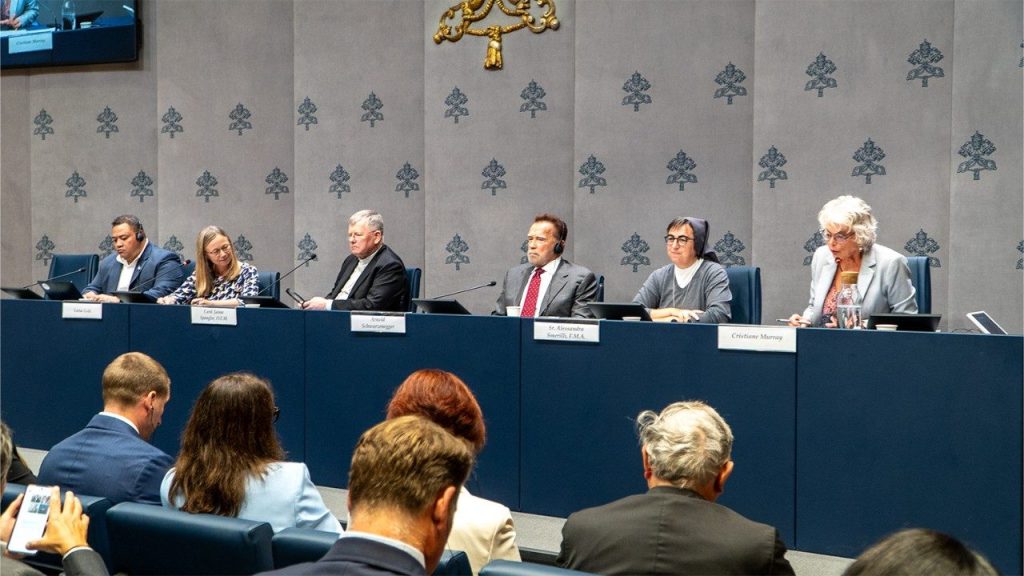
Cristiane Murray: Now we will hear from Sister Alessandra, whom we know very well. Beyond her institutional role, she is also a professor of political economy and statistics at the Pontifical Faculty of Educational Sciences Auxilium in Rome. She is committed to building bridges between faith, economics, and sustainability in order to promote a more just and environmentally respectful society, focusing on integrating theological, environmental, and social issues through an approach of integral human development. Sister, the floor is yours, please.
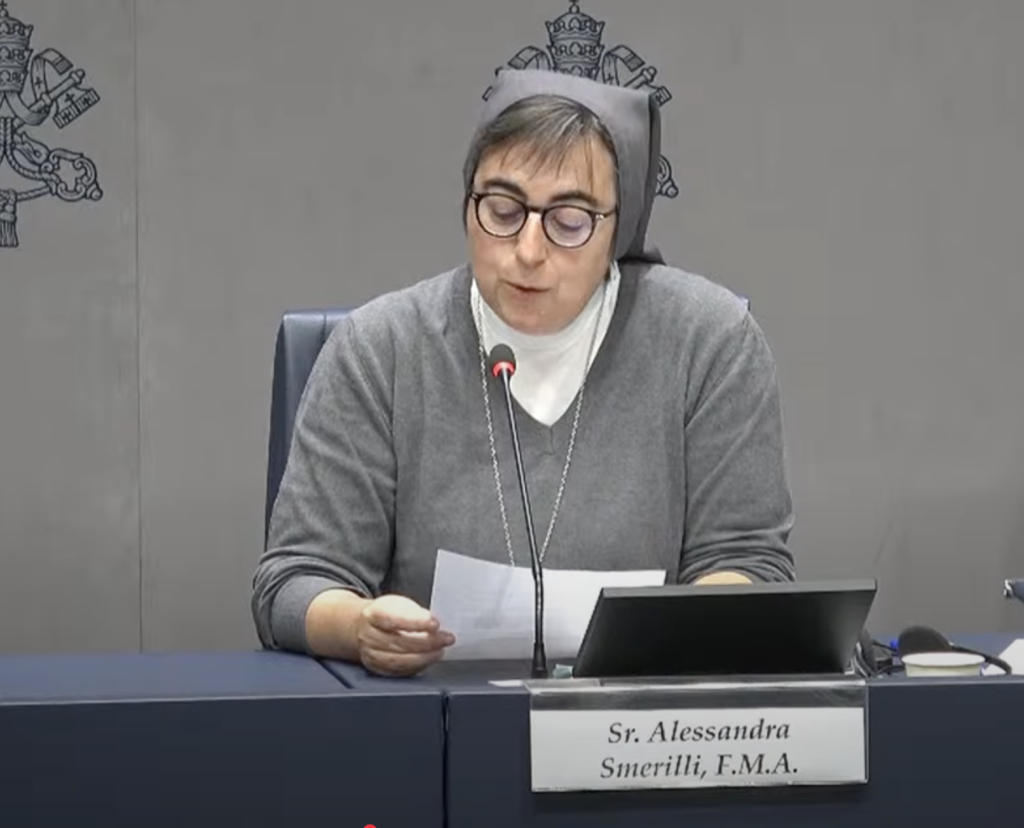
Sr. Alessandra Smerilli, F.M.A.: Thank you, thank you all for being here, and thanks also to those connected online. It is a joy and a pleasure for me to be able to speak today on the occasion of this press conference marking the beginning of a very significant event: the celebration of the 10th anniversary of the encyclical Laudato Si’ during the Jubilee Year of Hope, and with the presence of the Holy Father.
First of all, I want to thank the Laudato Si’ Movement, represented here by Executive Director Lorna, for organizing this conference and involving participants from the ecclesial, social, scientific, and political spheres. A beautiful example of a “church going forth.”
With Laudato Si’, ten years ago, Pope Francis gave us a text that was not only a magisterial document but a true roadmap for our time. With prophetic words, he reminded us that everything is connected, and that care for our common home is inseparable from justice for the poor, peace among peoples, and the affirmation of the dignity of every person.
Over the past decade, Laudato Si’ has touched not only the consciences of the faithful but also those of men and women of goodwill around the world. It has become a source of inspiration for many in diverse contexts. Today, we can say it has generated a genuine, global, and far-reaching movement—of which the Laudato Si’ Movement is one of the most vibrant expressions—that continues to grow and foster new initiatives for the care of creation.
The Dicastery for Promoting Integral Human Development, to which the Holy Father entrusted the mission of integrating the various dimensions of development while always keeping the human person at the center, has in these years sought to promote and accompany concrete pathways that bring the encyclical’s vision to life, drawing from the good that the Holy Spirit inspired in many local realities. We could say that Laudato Si’ has walked on its own feet; we have only tried to accompany this process.
In recent years, many local churches have supported ecological conversion processes in dioceses, parishes, schools, and Catholic universities. At the same time, initiatives such as the Laudato Si’ Action Platform have engaged families, religious communities, educational institutions, and businesses in multi-year journeys toward more sustainable and solidarity-based lifestyles.
Just this morning, I received a visitor from the Diocese of Lexington in the United States who gave me a book containing the very concrete plans each parish in the diocese had developed to live out Laudato Si’.
Among the most recent initiatives, I want to draw your attention to a project that Pope Francis held especially dear: the Laudato Si’ Village at Castel Gandolfo, inaugurated by Pope Leo this past September 5th, and which will host part of the upcoming conference.
This project is not only a tangible sign of how Laudato Si’ can be lived, but also a laboratory for the future. On the grounds and in the spaces of the papal villas, a place has arisen where faith, ecology, and culture harmoniously intertwine. A place where one can rest, breathe, contemplate the beauty of nature—and also the beauty of how we can produce without creating waste. It includes a training center for children, youth, adults, entrepreneurs, and CEOs, as well as job training for migrants, refugees, and women victims of violence, among others.
It is a model meant to show how everything is connected and that there is no separate social or environmental crisis—everything belongs together—and therefore it is a place of hope.
At the inauguration of the Laudato Si’ Village, the Pope reminded us that care for creation represents both a responsibility and a true vocation for every human being, to be carried out within creation itself, never forgetting that we are creatures among creatures—not creators.
The 10th anniversary of Laudato Si’ is therefore not a finish line, but a new beginning. It calls us to renewed commitment, because we know the challenges remain enormous: climate change, biodiversity loss, social inequalities, forced migrations, and conflicts that increasingly have environmental roots.
But, as we said earlier in our conversation, all these remain just words until the heart is touched by what is happening and a desire is born to respect creation. And yet, as Pope Francis reminded us, we cannot let our hope be stolen.
In Laudato Si’, he reminds us that external deserts multiply in the world because the inner deserts have become so vast, and that the ecological crisis is a call to profound inner conversion. The encyclical shows that each of us, personally and communally, has both a responsibility and an opportunity for conversion and change, starting with ourselves.
My wish is that these three days of prayer, reflection, testimony, and celebration will above all become an invitation to each person to look within, return to the heart, and reconnect with God, with others, and with nature. Because the future of the planet—our future—is not just a matter for governments. It concerns each of us, our families, our communities, the way we produce, consume, and relate to others and to creation.
I conclude with an exhortation from Pope Francis: Let us walk singing, that our struggles and our concern for this planet may not take away the joy of our hope. This is the invitation that resounds strongly today and that will accompany us in the days to come.
Thank you. A new beginning, an invitation to hope.
Featured photographs from Vatican News/Vatican Media.