We are delighted to welcome Dr. Jakub Kowalewski, Senior Laudato Si’ Research Fellow at St Mary’s University, London, as a guest contributor.
At a parish workshop on integral ecology in northern England, I found myself seated among a group of older parishioners. I had just begun working with the Guardians of Creation Project, and I expected the usual polite curiosity.
What I encountered instead was contagious energy.
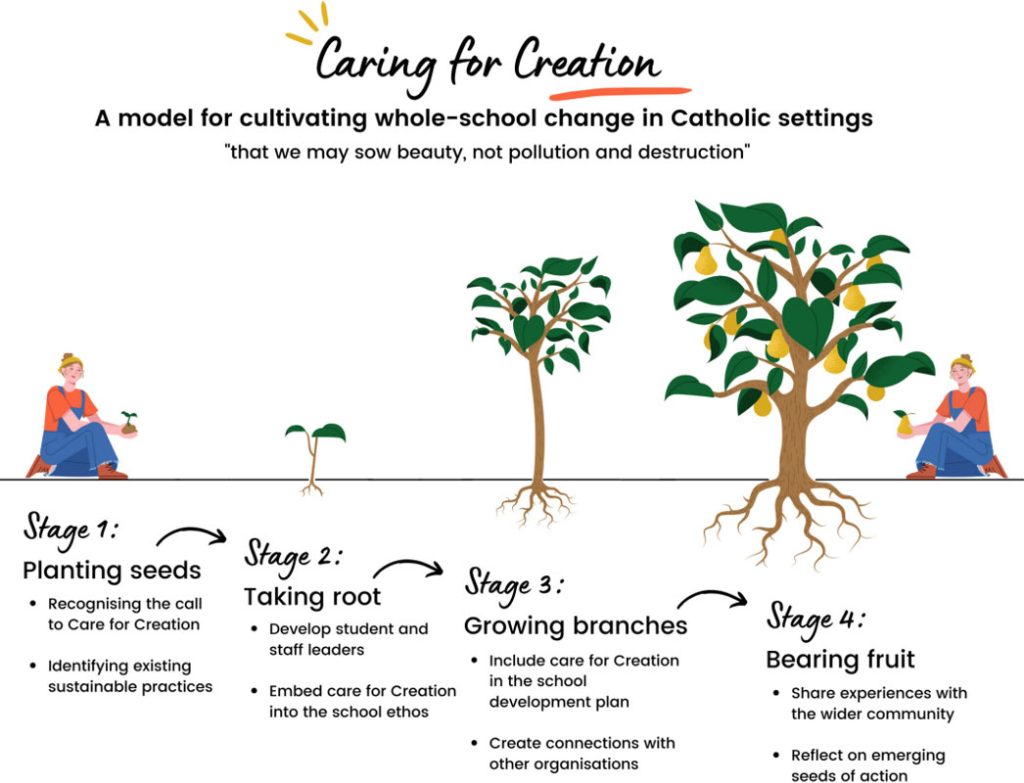
The “Caring for Creation” model. Adapted from: The Guardians of Creation Project (2022). Developing Whole-School Approaches to Sustainability in Catholic Education.
Attendees didn’t just want to learn. They were brimming with ideas. They spoke about transforming their parish grounds into spaces of biodiversity, reducing energy use in their buildings, and finding ways to accompany younger generations in climate action. These were not passive observers. They were doers. Some were already forming teams.
It was a moment that brought Pope Francis’s call for intergenerational solidarity into sharp focus. So often, we think of this as a duty we owe to younger generations—our children and grandchildren. But it’s also about the wisdom, courage, and fire of older generations, many of whom have been quietly committed to justice for decades.
That day, in that deanery, it became clear to me: caring for our common home is a calling that spans across age, ability, and background.
Small Acts, Deep Intuition
Later in the project, our team held focus groups with students from Catholic schools across England. We asked about their views on the environment, what they saw happening in their schools, and how they understood their role in caring for creation.
Some students’ words still echo in my mind. They couldn’t understand how people could still litter or still use fossil fuels. For them, these two actions were part of the same issue. It reminded me of Pope Francis’s reflection in Laudato Si’ (230):
“An integral ecology is also made up of simple daily gestures which break with the logic of violence, exploitation and selfishness.”
Still, we know that enthusiasm alone doesn’t overcome structural challenges. Many diocesan staff are already stretched thin, juggling multiple responsibilities.
How can sustainability be woven into diocesan life when there is barely time to address urgent needs?
One of the most effective solutions in England and Wales has been forming the Diocesan Environmental Leads network—a space where representatives from dioceses share tools, templates, experiences, and encouragement. It has allowed us to avoid reinventing the wheel, reduce isolation, and foster real partnerships.
Some dioceses, like Salford, are helping lead the way. Over 360 building audits have been completed, evaluating energy use and infrastructure. Hundreds of projects have since been initiated from parish improvements to decarbonisation plans for Catholic schools. Many now have solar panels generating clean energy, not just reducing costs but also forming a visible witness to ecological conversion.
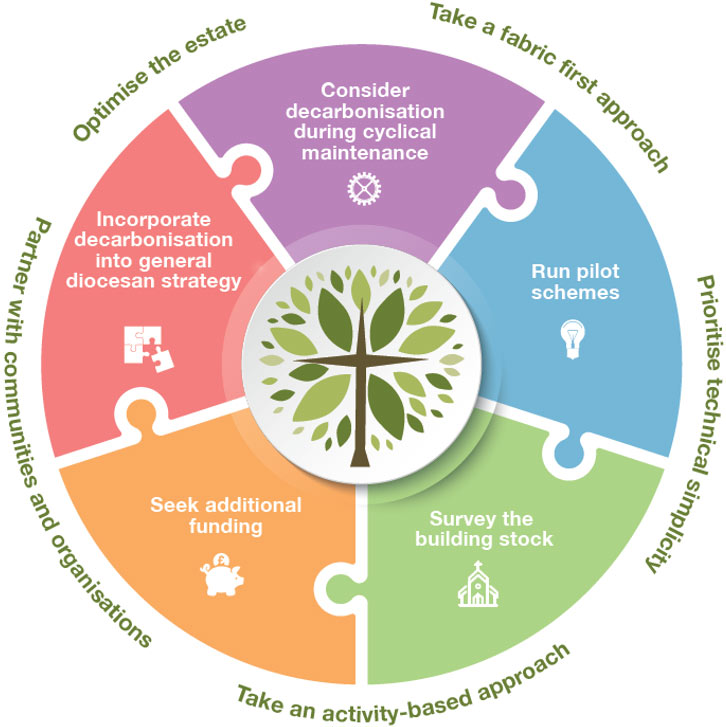
.A strategic framework for decarbonising diocesan building stocks.
Like many who care deeply about ecological justice, I sometimes feel overwhelmed. The scope of the crisis can leave us feeling powerless or anxious. But this work—building connections, listening across generations, facilitating real change—grounds me in hope. It reminds me that I am not alone, and that every small contribution matters.
Even the smallest seed can bear fruit.
A Word to Those Just Beginning
If your parish or community is just starting this journey, know this: don’t wait for everything to be perfect before you begin. Even small, improvised actions are meaningful. As Pope Francis reminds us in Evangelii Gaudium (§222), “Time is greater than space”—meaning that the processes we begin may grow beyond what we can see.
Every act of care, every choice to live more simply, is a way of participating in the renewal of the Church and the healing of creation. That is always worth doing.
Ready to Take the Next Step?
Inspired by Jakub’s reflection and the work of the Guardians of Creation Project? Explore the Laudato Si’ Action Platform to begin your own community’s journey. Under the goal of Adoption of Sustainable Lifestyles, you’ll find choices like the ones mentioned by the students of this story:
Remember: even small acts, when done with love, can help transform the world.