From Bishops to Parishes: How Croatia Is Building a Shared Path for Integral Ecology
Posted September 10, 2026
Across Croatia, care for our common home is increasingly taking shape not as a single initiative, but as a shared commitment across different levels of the Catholic Church. From the Croatian Bishops’ Conference and Catholic higher education to dioceses, parishes, schools, and local communities, a growing network is beginning to translate Laudato Si’ into pastoral life, education, and concrete action.
What is emerging is less a collection of isolated projects than the beginnings of a pathway: national leadership creating space for action, institutions building capacity, and local communities giving that commitment a concrete form.
From national leadership to local practice
At the national level, the Croatian Bishops’ Conference has established a structure dedicated to ecological concerns within its Centre for the Promotion of the Social Teaching of the Church. Through this work, care for creation is increasingly connected with the wider social teaching of the Church—not as an isolated environmental concern, but as part of the Christian responsibility for human dignity, justice, peace, and future generations. The presence of a commissioner for ecological issues within this structure provides an important point of connection for the development of integral ecology across the Church in Croatia.
Catholic higher education is also becoming an important part of this movement. At the Catholic University of Croatia in Zagreb, the University Center for Christian Responsibility and Care for All Creation is creating spaces where integral ecology connects research, teaching, student engagement, and action. During Laudato Si’ Week 2026, for example, the University brought together students, academics, volunteers, and international partners for discussions on integral ecology, student research, international exchange, and practical initiatives that promote more sustainable lifestyles. Sixteen student volunteers participated directly in organizing and delivering the activities, showing how a university can become not only a place to study ecological questions, but a place to practice ecological conversion.
Turning moments of action into a lasting pathway
At the diocesan level, this commitment is beginning to reach pastoral and educational communities. In May 2026, the Archdiocese of Rijeka held its first archdiocesan celebration of Laudato Si’ Week, bringing together children, families, educators, religious education teachers, parishes, and schools. Rather than being conceived as a single event, the celebration was the culmination of several months of educational and pastoral activities aimed at building ecological awareness among younger generations.
That longer preparation matters. It suggests a model in which Laudato Si’ Week is not simply an annual observance, but a moment that gathers and gives visibility to formation already taking place throughout the year.
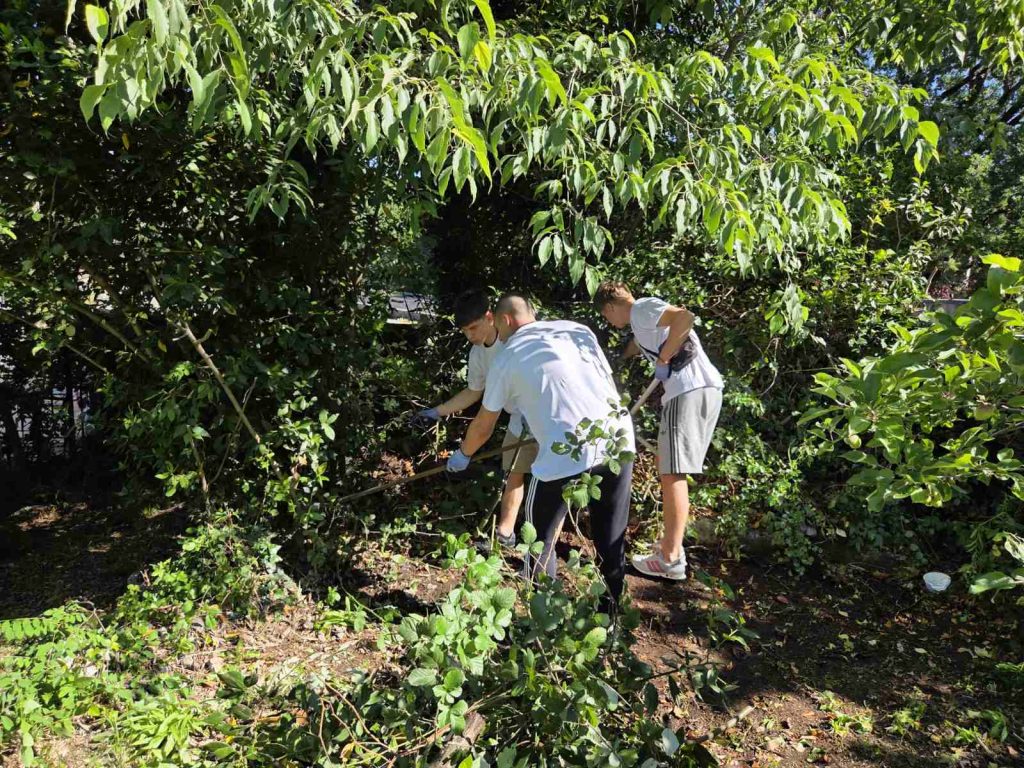
The scale of participation illustrates the potential of this approach. Children from three kindergartens and seven primary schools in Rijeka and surrounding communities participated, alongside First Communicants, parents, teachers, and parish communities. Students from several secondary schools also took part in an environmental clean-up around a parish church and the area beside the city cemetery, translating reflection on Laudato Si’ into a visible local action.
Taken together, these experiences show what can happen when institutions that often work in parallel begin to reinforce one another. A bishops’ conference can provide national leadership and coordination; universities can generate knowledge, formation, and new generations of leaders; dioceses can integrate integral ecology into pastoral priorities; schools can introduce it into education; parishes can root it in community life; and individuals and families can turn it into everyday practice.
Croatia offers a promising glimpse of what this can look like: a Church in which leadership, formation, and local action begin to move in the same direction—each strengthening the other in the shared work of caring for our common home.
This is also where the Laudato Si’ Action Platform can help connect the pieces. During the 2026 Laudato Si’ Week activities in Croatia, the Platform engaged with local Catholic actors to encourage their initiatives to join a broader global journey of ecological conversion. At the Catholic University of Croatia, this connection was explicitly explored through the “From Hope to Action” dialogue, linking the work of students and volunteers with the worldwide community participating in the Platform.
For other Platform participants, Croatia’s experience offers a practical lesson: ecological conversion becomes more durable when it is not carried by one enthusiastic person or institution alone, but supported by relationships across the Church. The question is not only “What action can we take?” but also “Who else needs to be part of the journey?”
The developments in Croatia therefore, point toward something larger than a successful Laudato Si’ Week. They show the beginnings of a country-wide pathway for integral ecology: one in which national Church structures, dioceses, universities, schools, parishes, and communities can reinforce one another while responding to the realities of their own contexts.
The next step is to deepen those connections and turn individual initiatives into sustained processes of ecological conversion, where planning, action, reflection, and learning become embedded in the ordinary life of Catholic institutions.
Croatia offers a promising glimpse of what this can look like: a Church in which leadership, formation, and local action begin to move in the same direction—each strengthening the other in the shared work of caring for our common home.