On April 16, 2026, we gathered for a rich conversation on “What a Just Transition Really Means for Catholics: Planet, Profit, and Care for the Poor.” The response from participants was inspiring—and the volume of thoughtful questions showed just how deeply this topic resonates.
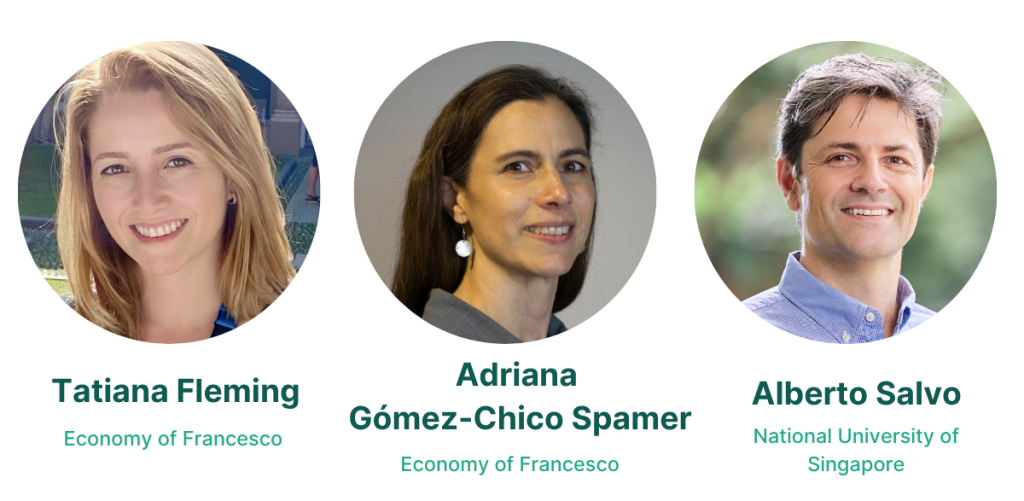
We were joined by three speakers bringing complementary perspectives: Tatiana Fleming, an economist working on green innovation and industrial transformation in Latin America; Adriana Gómez-Chico Spamer, an expert in the social and solidarity economy advancing models that reduce inequality; and Alberto Salvo, an environmental economist studying how real-world behavior shapes climate outcomes. Together, they engage questions that span from the technical—such as green technologies, labor markets, and economic systems—to the deeply personal, including moral responsibility, daily habits, and ecological conversion.
While we couldn’t address every question live, our speakers generously followed up afterward. Below is a selection of your questions, presented broadly in the order they were received—from systemic and structural concerns, to questions of work and consumption, and finally to personal responsibility and hope—along with their responses.
Responses have been lightly edited for clarity and length. The views expressed are those of the individual contributors and are shared here to support ongoing reflection and dialogue within the Laudato Si’ Action Platform.
How can grassroots economic models influence larger systems?
Adriana Gómez-Chico Spamer:
Little by little. Two complementary ideas among others:
Social norms can be changed. The behavior of individuals or individual economic agents is influenced by the behavior of other individuals or other economic agents. Many social experiments support this idea. But for small grassroots models or organizations to influence larger systems, they need to be visible. Initiatives that promote and show grassroots models in the academic field, in public policy, in business and finance, and in society in general are therefore valuable.
Another way to transform (little by little) the larger economic system is by doing business—by offering goods and services with attributes that the market is looking for while also generating positive social and environmental impact. A restaurant chain that buys its ingredients from rural cooperatives under fair conditions, or a company that buys healthy snacks from grassroots groups to offer in vending machines, are already contributing to transformation.
Does the Economy of Francesco aim to dialogue with existing systems, or offer an alternative?
Adriana Gómez-Chico Spamer:
It is not one or the other. It is both—and more. The aim of the Economy of Francesco is to contribute to a more just and sustainable reality for the poor and the environment. To give a new soul to the economy, as Pope Francis asked, social and economic structures need to be changed. New or alternative models can be part of this, but changing structures is broader than that. It is also a matter of culture and narrative. Dialogue is an important attitude in this process.
Why does “cognitive work” matter in a just transition?
Adriana Gómez-Chico Spamer:
Cognitive work means a kind of work where people have much more to give than just the repetition of tasks. It acknowledges people’s ability to learn while working, to improve, to make decisions, to take responsibility, and to share what they have learned with others.
Work in the Social and Solidarity Economy is neither a merchandise nor a resource, nor a substitute for machines. It is people working. Work should never be considered a commodity. Understanding work as cognitive—and actually organizing work in that way—is relevant and part of a just transition.
How do we address unconscious consumption habits that harm the environment?
Adriana Gómez-Chico Spamer:
To address something that is unconscious or habitual is not easy precisely because of that. Awareness is necessary for responsible consumption. According to behavioral economics, most of our decisions are made automatically. It is not that we don’t have information, but that we don’t necessarily take the time or effort to consider it.
We also face a present bias, which means we give disproportionate weight to costs and benefits in the present. This makes it harder to consider future generations in our decision-making.
Behavioral economics proposes “nudges”—low-cost, effective interventions for better decision-making. These should be designed according to specific contexts. Mapping the context, understanding decision processes, and identifying biases is necessary. Often, making the better choice the default option is a good starting point. For example, if you want people to stop using plastic bags, do not offer or display them unless requested.
Another important insight is that social norms can be changed. We are influenced by others’ behavior. This means testimony is not secondary—many social experiments support this.
Finally, consumption is not only individual—it is social. Our consumption affects others, but our better decisions also need support from others. We need community to sustain responsible consumption.
Is it a moral responsibility for Catholics to act when environmental harm is ignored?
Alberto Salvo:
My interpretation of statements by Pope Saint John Paul II, Pope Francis, and Pope Leo XIV is that the answer is the same as if “environmental harm” were replaced by “the poor,” given the dual cries of the Poor and the Earth.
So yes, I think Catholics seeking discipleship in Christ have a moral duty to question or act—always with a smile, avoiding judgment, and trying to see others’ perspectives.
Pope Leo’s call to action during the October 2025 Raising Hope conference extended beyond Catholics and Christians to all citizens. For Catholics specifically, he said: “Nor can we call ourselves disciples of Jesus Christ without participating in his outlook on creation and his care for all that is fragile and wounded.” The question becomes: how can each of us participate in that outlook?
How does personal ecological conversion shape broader transformation?
Alberto Salvo:
We face a collective action problem at a global scale. An ecological “examination of conscience” helps us name how everyday habits participate in structures of sin—especially overconsumption and indifference to those most affected.
As an educator, I believe personal ecological conversion begins with formation: learning to see creation as a gift and understanding the real impacts of how we live. For those of us among the “haves,” this takes shape in virtues like temperance and solidarity—cutting waste, choosing simplicity, and making room for others and for creation.
This conversion should not stop at private lifestyle changes. As our consciences are formed, we become more willing to support broader transformation—through the policies we advocate, the questions we ask, the institutions we belong to, and the economic choices we make—so that the common good and the dignity of the most vulnerable are protected.
What concrete examples or practices give you hope for a more just and sustainable future?
Alberto Salvo:
As a university educator, I am constantly surrounded by young people. I think they increasingly understand what is at stake, and that gives me hope that this understanding will be paired with a willingness to demand change—by choosing leaders wisely and becoming agents of change themselves.
I also draw hope from recent polls—even in polarized societies—showing that more people recognize the seriousness of global warming and support environmental protections.
How do we translate convictions into daily life?
Alberto Salvo:
Everyone may have a different approach, but here is mine:
I routinely think about how my actions—my economic “wants” beyond “needs”—translate into ecological outcomes, which often burden the poor first and harm other creatures.
Practically, I try to simplify: cutting or replacing habits I don’t value deeply, and “bundling” activities—sharing, pooling trips, repairing, reusing—so that resources are used more responsibly.
This brings a kind of interior peace, aligning daily life with what I believe. I remind myself that small actions matter. I also take comfort in faith: we do what we can, faithfully, knowing that God ultimately saves.
What does it mean for an economy to be “absorptive of skilled labor”?
Tatiana Fleming:
It means that the labor market is able to employ and make use of workers with specific skills. An “absorptive” market hires, remunerates, and deploys skilled workers whose expertise is needed to develop, operate, and scale green technologies and lead a just low-carbon transition.
What are examples of green technologies?
Tatiana Fleming:
Examples include solar photovoltaic panels, wind turbines (onshore and offshore), green hydrogen production, carbon capture and storage, direct air capture, energy storage systems (like batteries and pumped hydro), electrification technologies such as heat pumps and electric vehicles, smart grids, recycling technologies, circular economy processes, sustainable agriculture technologies, green building technologies, and nature-based solutions.
Editor’s note: Solar photovoltaic panels and wind turbines generate electricity from renewable sources like sunlight and wind. Green hydrogen is a cleaner fuel made using renewable energy, while carbon capture and direct air capture aim to reduce pollution by removing carbon dioxide from emissions or directly from the atmosphere. Energy storage systems like batteries help store power for when it’s needed, and electrification technologies—such as electric vehicles and heat pumps—replace fossil fuel use with electricity. Smart grids improve how electricity is distributed, while circular economy processes focus on reusing and recycling materials instead of wasting them. Finally, nature-based solutions and sustainable agriculture work with ecosystems—like forests or soils—to address environmental challenges while supporting communities.
Are green transitions too costly for developing countries?
Tatiana Fleming:
I agree that this claim is misleading. Green technologies vary in scale, and many already deliver short-term cost reductions. Costs for solar, wind, and batteries have fallen dramatically, and electric vehicle battery prices have declined by roughly 90% since 2010.
Benefits—such as reduced air pollution, lower fuel import bills, job creation, and improved energy access—begin accruing immediately.
For developing economies, a pragmatic path is to prioritize modular, scalable solutions such as distributed solar, mini-grids, energy efficiency, storage, and electrification.
Nuclear energy can play a role where firm low-carbon power is needed, but it often involves high upfront costs and long timelines, making it impractical for many developing countries. It is low in emissions, but requires careful waste management.
Is a just transition relevant in the Global North?
Tatiana Fleming:
Yes. The core principles are highly applicable. Technological innovation can be pro-work in both Global South and Global North if investment policies reskill the workforce for new human-machine complementarities.
Advanced economies already have an interest in promoting technologies that enhance human productivity rather than replacing workers—especially in sectors like health and education.
A new industrial policy grounded in collaboration between government and the private sector can help ensure that decarbonization and digitalization create high-quality jobs.
What skills are needed for a just transition?
Tatiana Fleming:
Education plays a key role by transforming human capital into an engine of structural change. It should prioritize the ability to “learn how to learn.”
Based on UNIDO’s green jobs pillars, key skills include:
- Engineering skills (design, construction, and assessment of technologies)
- Scientific skills (knowledge essential to innovation, such as physics and biology)
- Operations management (organizational change, lifecycle management, cooperation across sectors)
- Monitoring skills (environmental compliance, legal frameworks, emergency management)
Continue the Journey
You can watch the full webinar recording anytime in your Laudato Si’ Action Platform dashboard. If you don’t yet have an account, we warmly invite you to enroll and join this global effort working together to care for our common home.