
Signature story 02 · Chile / Nigeria / Canada
After everyone goes home.
Planting a tree can take minutes. Growing one asks for water, hands, institutions—and sometimes a horizon longer than a human life.
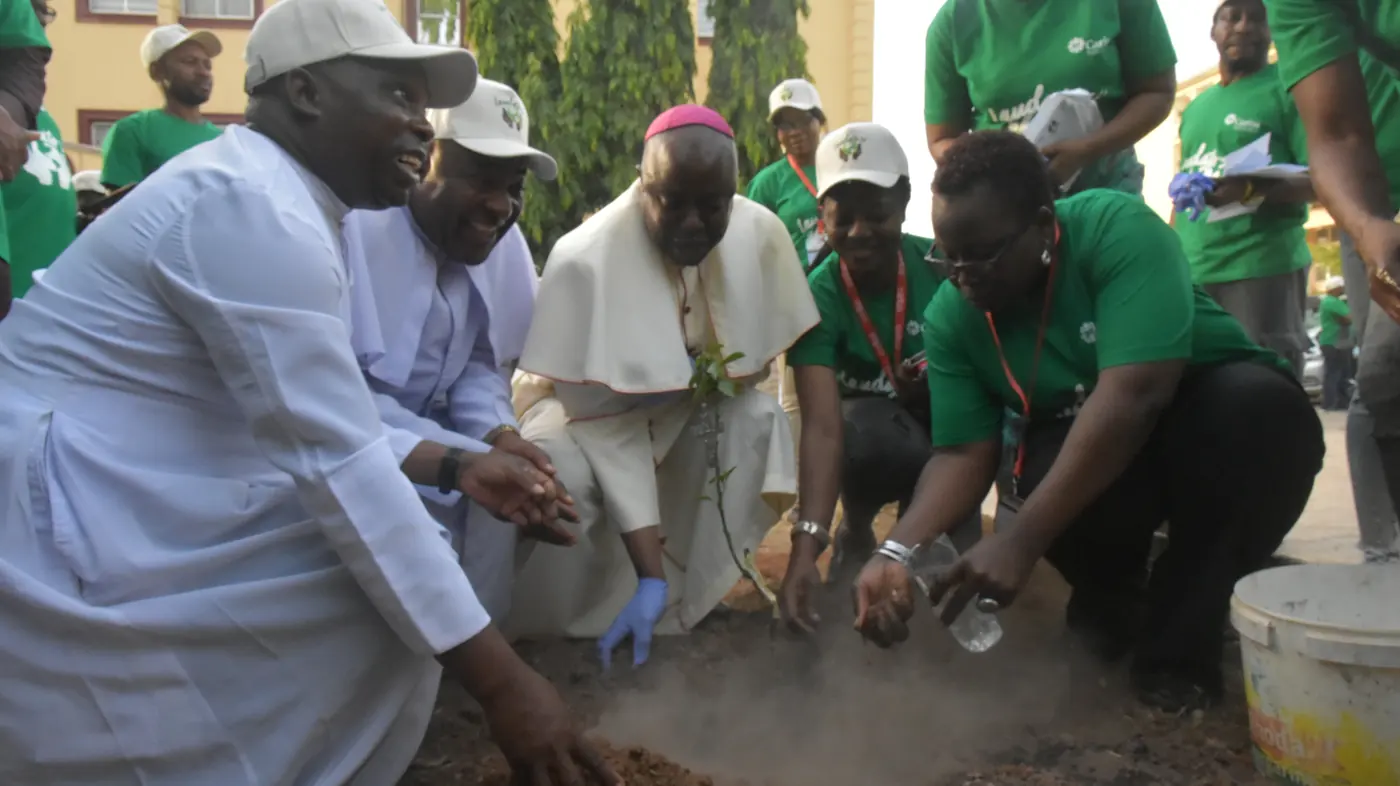
Church leaders and volunteers at a tree-planting event in Nigeria, 2024.
“I will never forget this day.”
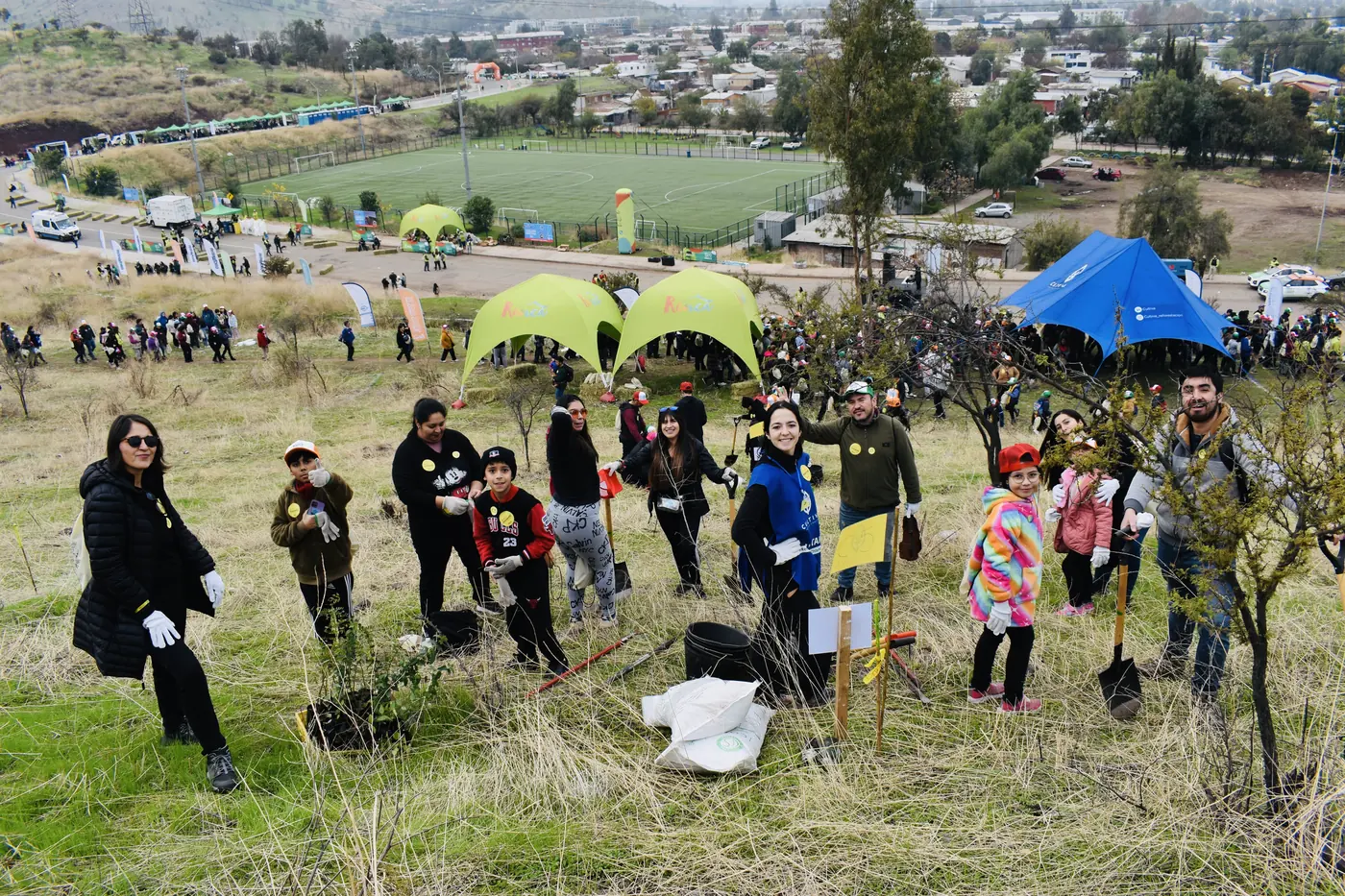
Native-tree planting around the Laura Vicuña Sanctuary, Santiago, 2024.
On a hillside in northern Santiago, Chile, families once spread out across the pale grass carrying gloves, shovels and young trees, with football fields, roads and the roofs of Renca visible below them. It was 2024, and more than 2,000 native trees were being planted around the Laura Vicuña Sanctuary as part of the municipality’s 130th anniversary. Among the participants was a little girl who turned to her mother and said, “I will never forget this day.”
Trinidad Donoso, then the sanctuary’s Communications Manager, remembered the remark because it seemed to reveal something larger than the event itself. “This shows us that we are not just planting trees,” she said. “We are planting seeds in the hearts of people.”
Sr. Marianela Sánchez spoke about the same day in terms of legacy. “We used to think of legacy as something material that we would pass on to our children,” she said. “But today, it is for the planet. These small actions are for the children. We have no other choice.”
The beginning is visible.
A shovel enters the ground. A sapling is lowered into place. Hands push the earth back around it.
There is a reason planting days can be so well recorded by photography. Across the Laudato Si’ Action Platform, that gesture has become familiar. Since action tracking began in May 2025, Platform participants have marked “Plant native trees” as “complete” 126 times.
But a reported completion can represent radically different scales of work, and the data tells us only that someone marked the action complete. It cannot tell us whether someone came back with water in the dry season, whether the tree survived, or whether responsibility for it ever became part of the life of the community. The original Chilean story understood that risk already.
Persistence, consistency, and teamwork.
Not planting. Growing.
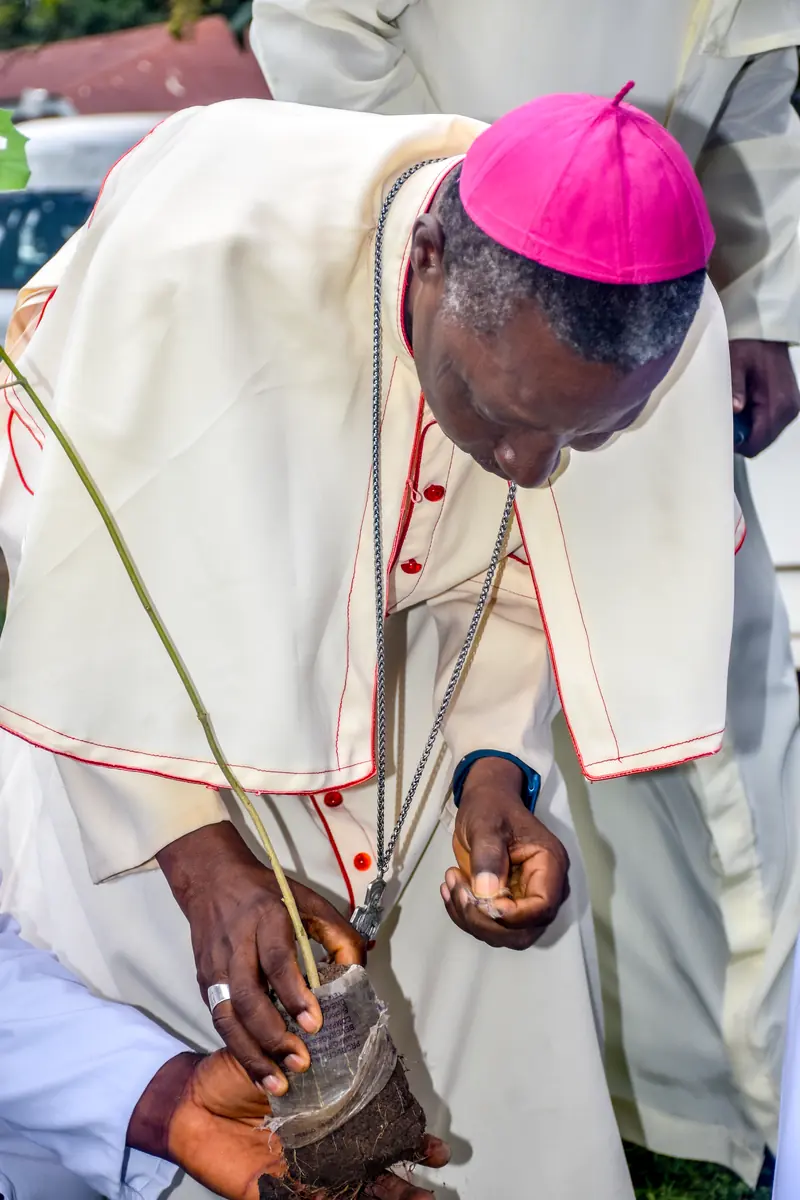
A recent photograph from Nigeria catches a church leader bending almost to the ground beside a young tree. His white cassock brushes close to the soil; another man leans over his shoulder while a third steadies a tool. The focal point of the photograph is not the bishop or cardinal at its center, but the fragile sapling beneath him.
That image belongs to a national Catholic tree-growing campaign launched by the Catholic Bishops Conference of Nigeria in 2023, with dioceses encouraged to work toward planting 20,000 trees annually over five years.
Caritas Nigeria framed the campaign as a response to very different ecological pressures across the country, from desert encroachment in the north to erosion and flooding elsewhere. Even when the Platform first told the participant story in 2024, Dr. Emmanuel Okechukwu insisted that the important word was not planting but growing. The mindset, he said, had to shift from viewing planting as “a one-off event” toward “planting, nursing, nurturing, watering, protecting, and growing the seedlings for at least three years.”
What happens after the ceremony
Two years later, Dr. Pascal Onu describes a campaign that is still in process, but unevenly. “The campaign remains ongoing, although with fickle momentum,” he says. The number of trees planted has continued to rise, but the original targets remain difficult to meet. The reasons are stubbornly practical: weather, water, manure, protection from damage, enough people to return after the first day. “The biggest challenge remains plant watering and manuring, especially at the early stages of growth,” Onu explains. “There is also the issue of funding, because only areas with available volunteers undertake the responsibility of the tree-growing process. Other areas would require recruiting personnel to do the job.”
For Onu, this has made the distinction between planting and growing much sharper. “There should be a paradigm shift from the phrase ‘tree planting’ to ‘tree growing,’” he echoes, because survival depends on “not only a one-off planting but also watering, manuring, application of pesticides—preferably organic—and the protection of seedlings in cages against human attacks.”
There should be a paradigm shift from the phrase ‘tree planting’ to ‘tree growing.’
What seemed at first like an environmental activity becomes, very quickly, a question of community ownership. He says the dioceses that have done better are those that “were able to mobilise their parishioners and communities well enough to take ownership of the plants and process,” following through after the event rather than leaving responsibility with the original organizers. Looking back, he now emphasizes “full community involvement and ownership,” proper siting, and even the possibility of community tree-growing committees to monitor the work over time.
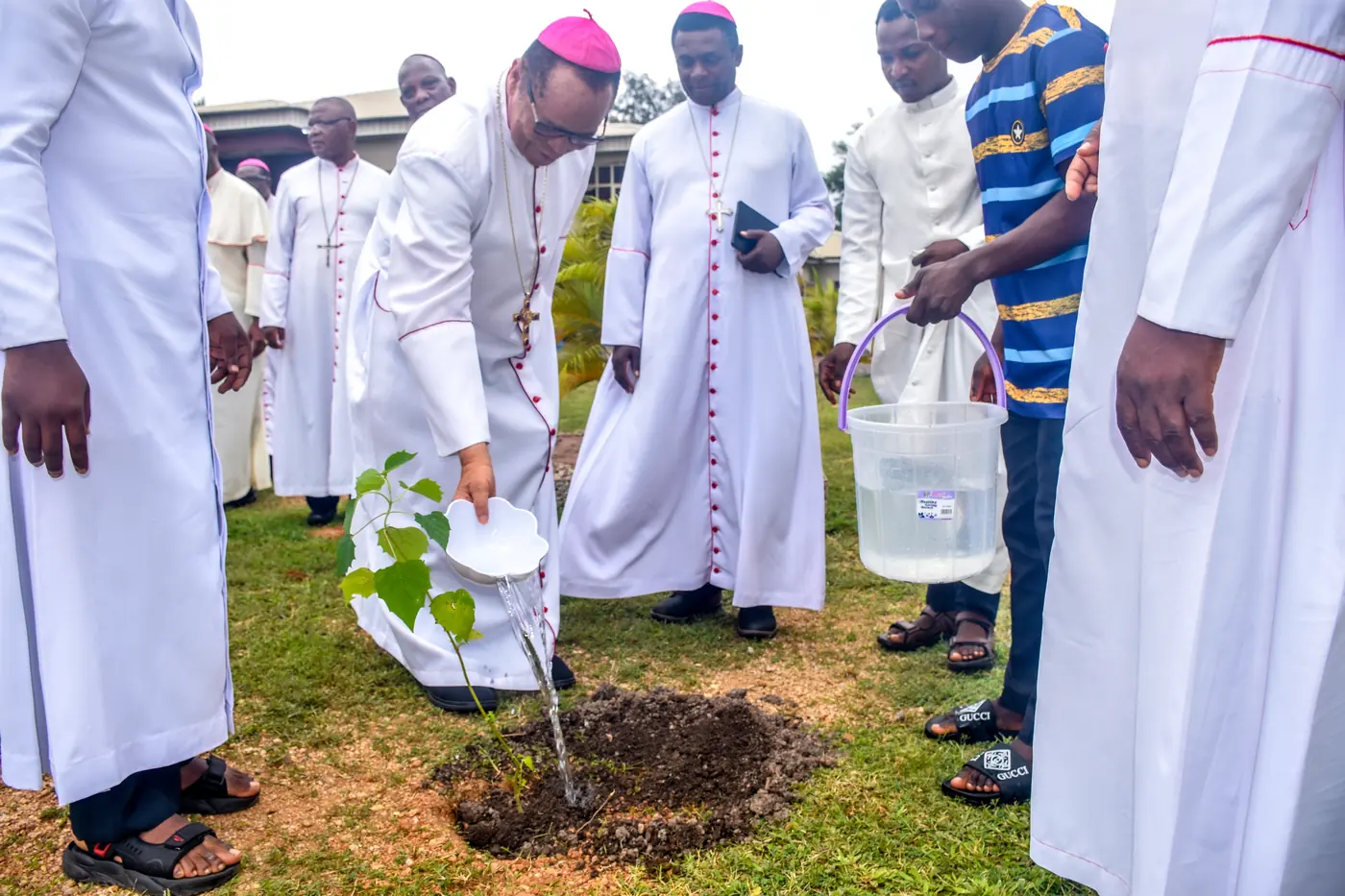
One diocese made that logic unusually clear. According to Onu, it refused to let the Caritas team plant at all unless there was first a credible plan for watering the trees until they had reached a greater degree of maturity.
The refusal sounds almost contrary to the spirit of a planting campaign, but in practice it may have expressed the campaign’s deepest lesson: sometimes taking a tree seriously means deciding not to plant it yet. In Yola Diocese, by contrast, stronger community mobilization has helped produce a reported survival rate of approximately 53 percent among planted trees. That figure matters because it measures something less photogenic than a planting ceremony: what was still alive later.
53%
of planted trees still alive in Yola Diocese, where stronger community mobilization has helped.
Onu is equally clear that the same response will not fit every place. “Terrain differences create some form of disparity across dioceses,” he says, noting that tree growing may be particularly important in parts of northern Nigeria while communities in the south may identify other approaches better suited to their environmental pressures.
The response will not fit every place alike. Stewardship begins by knowing the terrain—and by staying.
A horizon longer than our own
The trees make visible what a newly planted sapling cannot: time.
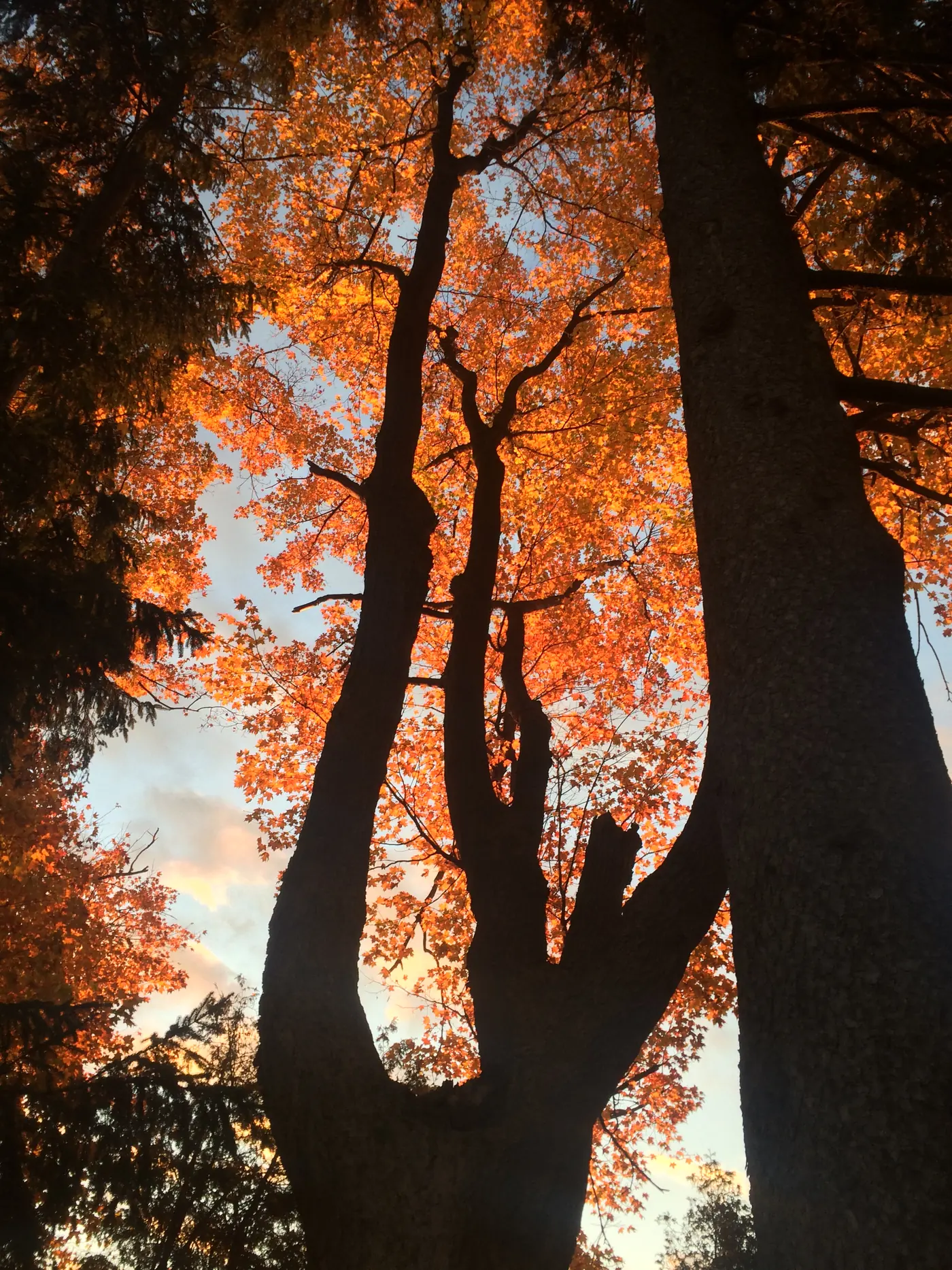
Old-growth forest at Ignatius Jesuit Centre, Guelph, Canada.
The photographs from the Ignatius Jesuit Centre in Guelph feel almost like the answer to a planting-day image taken centuries too early. In one, the camera looks upward through dark trunks toward a canopy glowing orange in the late light. The trees are large enough that a person standing beneath them would disappear into the scale of the forest. The image makes visible what a newly planted sapling cannot: time.
The Old-Growth Forest Project began in 2006, when Ignatius Jesuit Centre and community partners began considering how approximately 93 acres of former agricultural land, existing forest, wetland and waterways could be restored as a healthy forest ecosystem. Its horizon is 500 years. “The 500-year horizon grew from a simple recognition,” Andrea Scapinello explains. “An old-growth forest cannot be created within a conventional project timeline. We can restore habitat, plant trees, remove invasive species, and create the conditions for a healthy forest, but the forest itself has to develop over generations.” Instead of asking what could be completed in a few years, he says, the project began asking “what we can begin now that others will continue long after us.”
Three horizons
From an afternoon to five centuries
- An afternoon Santiago More than 2,000 native trees planted around the sanctuary.
- 3 years Nigeria Planting, nursing, nurturing, watering, protecting.
- A human life “The people who began this project will not see its completion.”
- 500 years Guelph The horizon of the Old-Growth Forest Project.
Time on a logarithmic scale: each step to the right is roughly ten times longer.
This does not have abstract implications. Stewardship now means planting native trees and shrubs, restoring habitat, managing invasive species, monitoring ecological change and caring for waterways while former farmland moves slowly through succession toward meadow and forest.
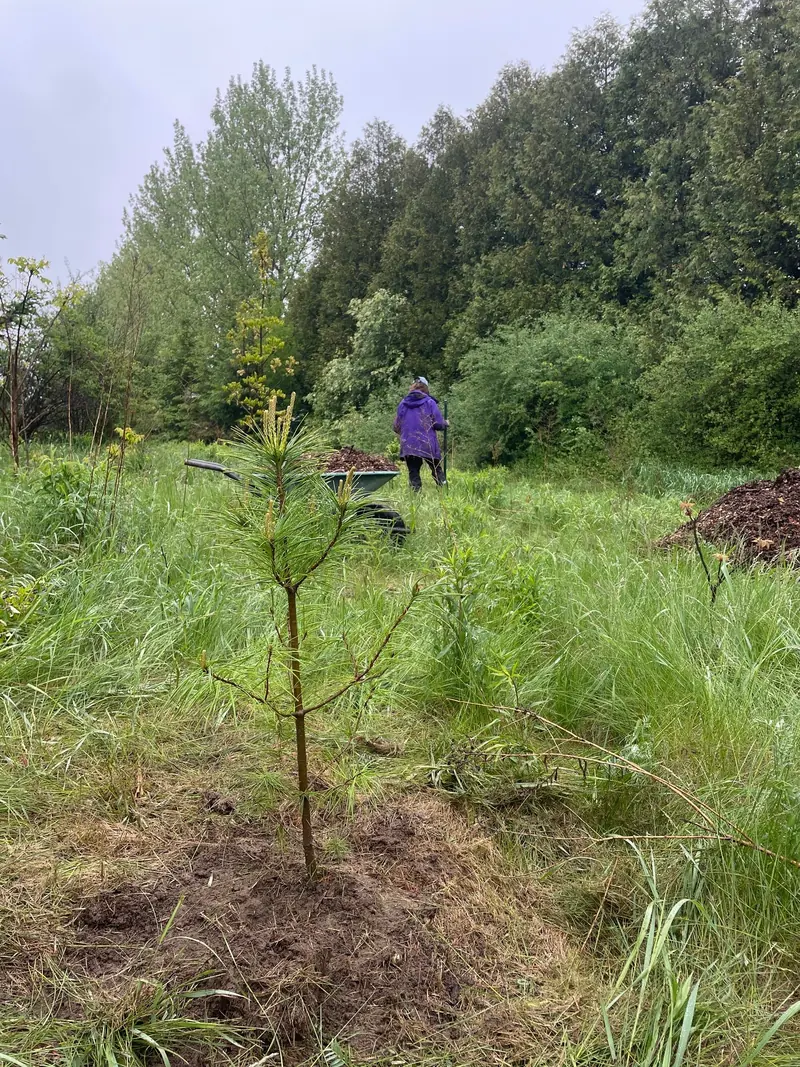
Much of that work is done with students, volunteers and community partners, and Scapinello treats their participation as part of the restoration itself. “We are not only growing a forest,” he says. “We are also building the community knowledge and commitment that will be needed to care for it into the future. In that sense, cultivating future stewards is as important as cultivating trees.”
The 500-year horizon also forces the institution to admit what it cannot control. “The people who began this project will not see its completion, nor will the people caring for it today,” Scapinello says. “Staff will change, ecological conditions will change, and the needs of the forest will change. That means we cannot depend on individual enthusiasm alone. The commitment has to become institutional and communal.”
The commitment has to become institutional and communal.
At Ignatius Jesuit Centre, that means a conservation easement protecting the land, along with restoration, ecological monitoring, documentation, education and community involvement designed to move knowledge and responsibility from one generation of stewards to the next. Even then, Scapinello resists the temptation to imagine the future too precisely. “We can establish a direction, but we cannot prescribe exactly what this landscape should look like centuries from now. Future generations will know things we do not, and the forest itself will continue to teach them.”
One of the most important moments in the project’s history involved no planting at all. In 2010, the Centre removed a dam that had altered Marden Creek for nearly 180 years. Once the obstruction was gone, the creek began flowing freely again and re-establishing its cold-water ecosystem; fish species that had not been documented there for decades returned. “There is something instructive in that act,” Scapinello says. “Restoration is not always about adding something to the landscape. Sometimes stewardship means removing an obstacle and allowing natural processes to resume.” The project can plant trees and restore habitat, he says, “but ultimately we are not creating an old-growth forest ourselves. We are creating conditions in which a forest can grow, change, and eventually become something that none of us can fully anticipate.”
Put these landscapes beside one another, and they barely resemble each other: an open hillside above Santiago, a young tree beneath the hands of Church leaders in Nigeria, and an Ontario forest whose future is measured in centuries. Yet the same question runs through all three. The Chilean story understood planting as legacy. Nigeria asks whether the tree survives long enough for that legacy to mean anything. Guelph stretches the question still further, asking whether an institution can remain faithful to work whose fullest outcome it will never possess.
Scapinello puts that spiritual shift in one question. A project like this, he says, changes the measure from “What can I accomplish?” to “What can we set in motion and faithfully hand on?”
After everyone goes home
Back on the hillside in Santiago, the little girl may indeed remember the day she planted a tree. But the future of that tree depends on all the less memorable days that come after it.
Planting is a moment. Growing is what happens afterward.
The hillside around the Laura Vicuña Sanctuary, Santiago, 2024.
Signature stories · Five years of the Laudato Si’ Action Platform
Keep reading
-
 Rebuilding Our Churches
What does it mean to rebuild a church?
-
 The Same Bottle
What becomes visible when the same ordinary object passes through different hands.
-
 What the Land Asks of Us
River, tidal flat and soil — three places close enough to change the people who stay with them.
-
 What We Pass On
A family inheritance of faith, land and care.
From the Laudato Si’ Action Platform annual report. Celebrate five years with us →