
At the Laudato Si’ Action Platform’s fifth-anniversary gathering in Rome, participants moved beyond celebrating what has been accomplished to ask a harder question: how does ecological conversion take root and endure?
The fifth anniversary of the Laudato Si’ Action Platform was an occasion to look back. But after five years, looking back could only take us so far.
After the announcements, stories and milestones came another question: What makes change last?
On November 6, roughly 120 participants gathered for the anniversary program, with registration records representing at least 29 countries across Africa, Asia, Europe, Latin America, North America and Oceania.
The diversity was not only geographic. Around the same tables were bishops and episcopal vicars, priests and religious sisters and brothers, diocesan and bishops’ conference leaders, university professors and researchers, educators, Catholic health leaders, Caritas and civil-society organizations, youth organizers, ecological advocates, communicators, philanthropic partners, and people working in finance and economic transformation. Officials and representatives of the Holy See and Vatican institutions joined people leading ecological work in local Churches and communities around the world.
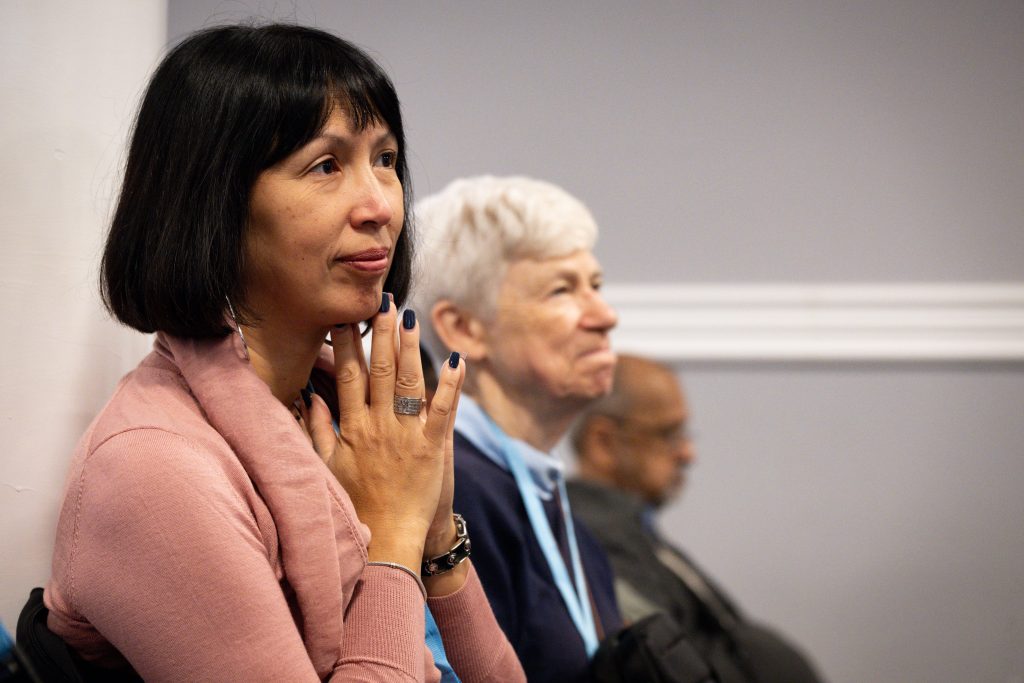
Emanuela Chiang and Sr. Sheila Kinsey listen during the fifth-anniversary conversations on ecological conversion and the future of the Platform.
Among them were representatives connected to the Federation of Asian Bishops’ Conferences, the Mexican and Brazilian bishops’ conferences, the Archdiocese of Lagos, Caritas Bangladesh, the USG-UISG JPIC Commission, the Pontifical Academy of Theology, universities across several continents, religious congregations and ecclesial movements, Catholic climate networks, foundations, and grassroots organizations.
That range mattered.
The gathering was not intended to suggest that one model of ecological conversion could simply be reproduced everywhere. A diocese in Nigeria, a religious congregation working across dozens of countries, a university in the Philippines, a community defending an ecosystem, and a Catholic institution reconsidering its investments encounter very different realities.
What they could ask together was a different question: What allows transformation not only to begin, but to last?
From seven goals to the realities behind them
The day before the main anniversary program, participants returned to the seven Laudato Si’ Goals in a workshop devoted to reflection and exchange.
That was an important starting point. The Goals can give a community a common language, but they are not meant to remain categories on a page. Response to the Cry of the Earth may mean protecting a watershed in one place and changing an institution’s energy use in another. Ecological Economics can involve budgets, investments or livelihoods. Community Resilience may begin with who gets to participate in a decision.
Friday’s conversations made those differences tangible.
Rodne Galicha, Executive Director of Living Laudato Si’ Philippines, traced years of work across the seven Laudato Si’ Goals—but some of the most powerful moments in his presentation came through stories of what that work looked like before it had a framework or a name.
He recalled communities in the Philippines pitching tents and celebrating Mass in the rain to block mining operations, and moments when people stood their ground with little more than a bamboo stick and a rosary. He also remembered a colleague whose defense of land and community ultimately cost him his life—an eco-martyr whose witness made clear that care for creation can carry profound human consequences.
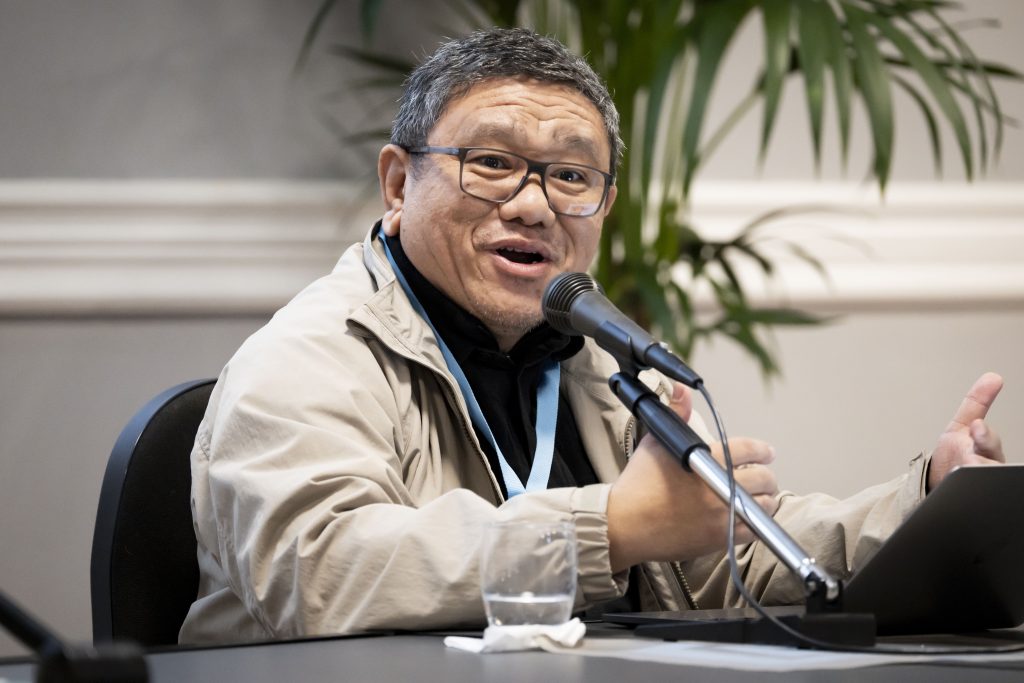
Rodne Galicha of Living Laudato Si’ Philippines shares lessons from years of community-led ecological action and advocacy.
Against those stories, the language of “community resilience” became much more than a programmatic idea. Rodne’s wider presentation traced how that same commitment has grown into diocesan accompaniment, biodiversity protection, sustainable lifestyles, ecological education, advocacy and community organizing. The pattern was continuity: communities owning the change, institutions living their commitments, and care continuing long after a campaign or event has ended.
Sr. Chanda Constance Nsofwa, FMA, showed another expression of that continuity through the worldwide network of the Daughters of Mary Help of Christians. Their approach emphasizes transferring agency to communities, developing collective habits rather than depending on individual leaders, and enabling young people to become active stewards of ecological conversion. Concrete examples ranged from photovoltaic panels at an agricultural school in Chile to ecological projects led by students, coastal cleanups and agriculture supporting education in South Sudan.
Mateusz Ciasnocha, founder of the Farm of Francesco, offered an especially simple way of holding these ideas together: lasting transformation needs a large vision, concrete action and a willingness to treat small actions with seriousness.
None of these approaches looks exactly the same. That is part of the point.
A Church whose structures tell the same story as its words
For Sr. Maamalifar M. Poreku, MSOLA, Co-Executive Secretary of the Justice, Peace and Integrity of Creation (JPIC) Commission of the USG and UISG, the question of ecological conversion went directly to the credibility of the Church itself. Her work with the Commission connects religious congregations around the world around justice, peace and care for creation, including bringing grassroots concerns into wider Church and international conversations.
Her reflection, shared in the panel titled The Church We Need for Ecological Conversion, challenged institutions to move ecological responsibility from statements into leadership priorities, pastoral planning, budgets, investments, formation, governance and accountability. She argued that conversion cannot remain only personal: it must become visible in the decisions institutions make.
As she put it:
“The decisive question is not only what the Church teaches about caring for our common home, but whether its own structures, decisions, and use of resources and power embody that teaching.”
It is a demanding standard because it turns ecological conversion inward as well as outward. A parish can preach about care for creation and still ask how it purchases energy. A university can teach sustainability and still examine its investments. A diocese can encourage ecological action while asking who participates in its decisions and how progress is measured.
Sr. Maamalifar summarized the challenge in another way: “Ecological conversion must be both personal and communal, spiritual and practical.”
The Platform exists precisely in that space between conviction and practice.
In an age of AI, what—and whom—is technology serving?
One of the most forward-looking sessions of the gathering brought that same question into the world of artificial intelligence.
Ivan Efreaim A. Gozum, a theologian at the Institute of Religion of the Pontifical and Royal University of Santo Tomas in the Philippines, led a presentation on AI and integral ecology, followed by an interactive workshop asking participants to look beyond the apparent immateriality of digital technology. AI depends on data centers, electricity, cooling systems, minerals, factories and human labor. Its ecological footprint therefore cannot be separated from questions about the people and places that bear those material costs.
But the workshop did not stop with environmental impacts.
Participants were invited to consider technology through the lenses of human dignity, ecological integrity, social justice, participation and accountability: Who benefits? Who bears the risks? Can affected communities influence a system? And who remains responsible when technology fails or causes harm?
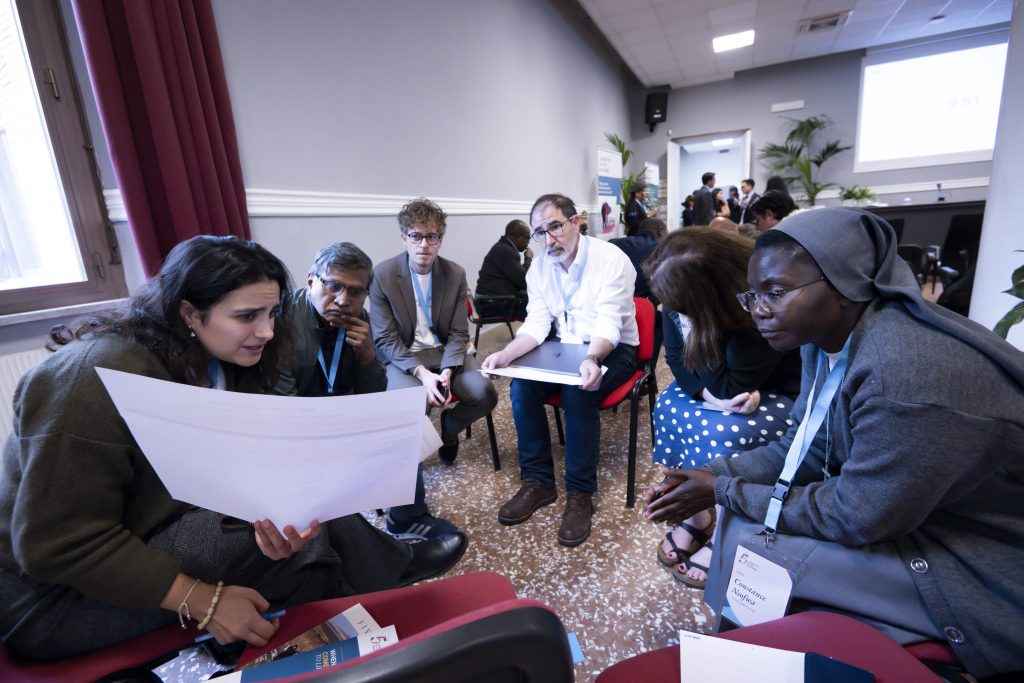
Participants discern the possibilities and tensions of artificial intelligence through the lens of integral ecology during an interactive workshop led by Ivan Gozum.
The exercise then turned toward institutional discernment. Rather than asking only what AI can do, participants considered what Catholic institutions should choose to build, use, limit or refuse—and how technological decisions might become more humane, just and ecologically responsible.
The workshop surfaced a wide range of discomforts, questions and possibilities around AI. But beneath those differences was a shared instinct: not to fall into the technocratic paradigm by treating technology itself as the answer. Again and again, participants returned instead to the human person, to relationships, to community and to place. The question was not simply what these tools can do, but how they might be judged by whether they deepen human dignity, strengthen participation and remain attentive to the ecological and social realities in which they are used.
Listening before deciding
John Paul de Quay, co-founder and director of The Ecological Conversion Group in the United Kingdom, approached that problem from almost the opposite direction. Rather than beginning with emerging technology, he began with the local community: how listening, relationship and synodal discernment can help people identify the ecological actions appropriate to their own place and circumstances.
He presented Building a Caring Community, a new set of offline Laudato Si’ Action Platform resources designed to help communities reflect, plan and act even where digital participation may not be practical. The resource uses a simple cycle of seeing, judging, acting and returning to reflection, grounding the Laudato Si’ Goals in Scripture and Catholic social teaching.
But for John Paul, the method mattered as much as the resource itself.
“Synodality is at the heart of these resources,” he told participants. He described synodality as a way of resisting the assumption that the correct action can always be determined in advance by an organization, an algorithm or a predetermined program. Listening creates room for the particular reality of a place to change the answer.
“Synodality is a disposition of listening rather than the imposition of ideas and actions on others,” he said, before posing a question that could have served as a thread through much of the gathering: “For what and for whom are we working?”
That question matters for an offline community resource. It matters for artificial intelligence. It matters for institutional planning. And it matters for the Platform itself.
Making a global community visible without reducing it to data
Across the anniversary week, cartographer and geospatial technologist Molly Burhans also shared the new Atlas of Laudato Si’. Burhans, who is pursuing doctoral studies in social sciences at the Pontifical University of Saint Thomas Aquinas and serves as the inaugural Ignazio Danti, O.P. Fellow in Geography at The Catholic University of America’s Leonum Institute, has collaborated with the Platform on the geospatial work behind the Atlas. The project offers a new way of seeing the geographic breadth of participation in the Platform and the communities behind it.
Find your community on the Atlas of Laudato Si’
A map cannot tell the whole story of ecological conversion. It cannot capture every relationship formed, every institutional struggle or every small decision sustained over time.
But it can help us see something that is otherwise difficult to hold together: that actions taking place in very different contexts belong to a wider journey.
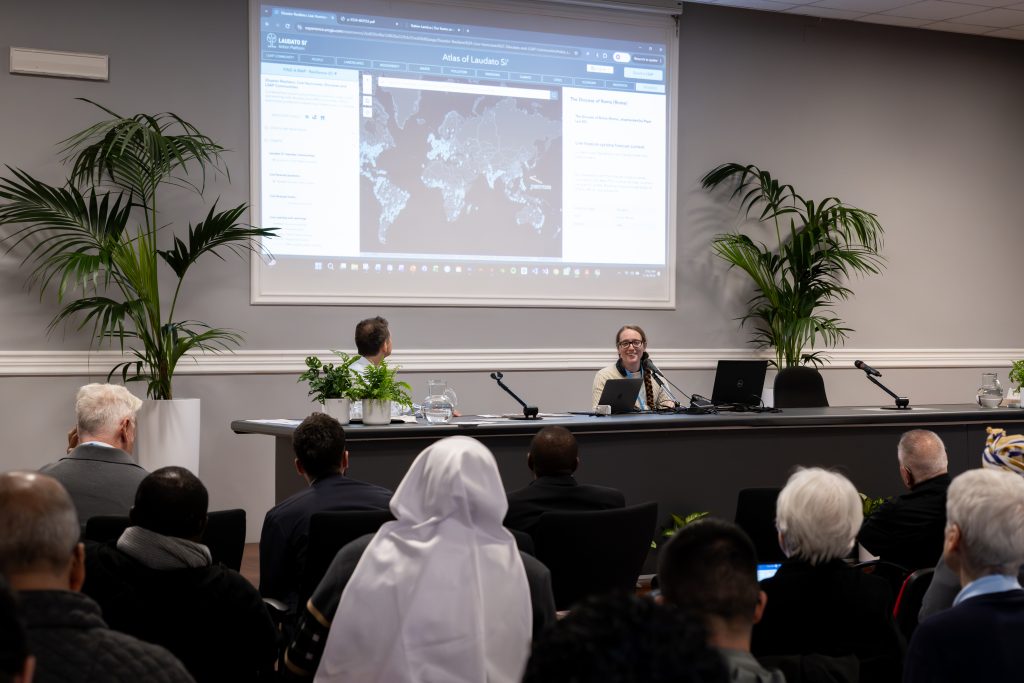
Molly Burhans presents the Atlas of Laudato Si’, showing how participation in the Platform can be understood across places and communities around the world.
The Atlas also placed an important tension before the gathering. Data can help communities understand patterns, recognize participation and make better decisions. But—as the conversations about AI and synodality repeatedly underscored—information must remain at the service of people rather than replacing the particularity of their experience.
The challenge is not simply to collect more information. It is to turn information into wisdom, relationship and responsible action.
Learning to act together
That relational dimension extended beyond Catholic institutions.
Anna Maria Sclavo of the Dicastery for Interreligious Dialogue shared examples of ecological cooperation across religious traditions: Catholics, Buddhists and Muslims participating in tree planting and “tree ordination” in Cambodia; Muslims, Catholics and others cleaning the area surrounding the Great Mosque of Rome; and the SVD Laudato Si’ Farm in the Philippines bringing together prayer, farming, food and people of different backgrounds.
These examples offered another answer to the question of what makes change durable: relationships strong enough to sustain common action even across differences.
Integral ecology, after all, cannot be practiced alone.
From commitment to prayer
The anniversary program concluded not with a final presentation, but with commitments and prayer.
Participants were invited to articulate what they would carry forward from the gathering before joining the Mass for the Care of Creation, celebrated by Cardinal Fabio Baggio.
That movement—from listening, to discernment, to commitment, to Eucharist—gave the gathering its deepest shape.
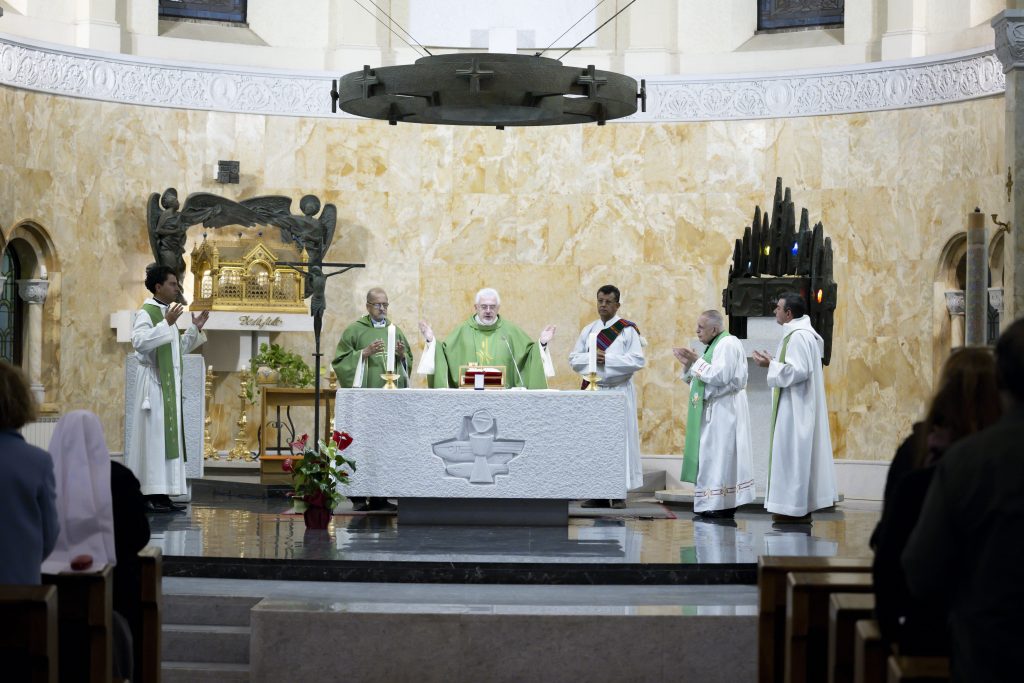
Cardinal Fabio Baggio presides at the Mass for the Care of Creation, concluding the Laudato Si’ Action Platform’s fifth-anniversary gathering in Rome.
It also kept the anniversary from becoming simply a celebration of an organization or a record of five years of activity. The Platform exists to serve a conversion that is larger than itself: a way of living faith that changes how communities relate to creation, to one another and especially to those most affected by ecological and social harm.
And the people who gathered in Rome represent only a small part of that story.
Thousands of institutions, communities, families and individuals participating in the Laudato Si’ Action Platform were not in the room. The significance of these days therefore cannot depend on having been present. It depends on whether the questions raised in Rome travel outward.
Who has ownership of the changes we are making?
Do our institutions embody the values we proclaim?
Are our technologies serving people and creation?
Are we listening before deciding?
And, five years from now, what will still remain because we chose to keep caring?
Rodne Galicha’s presentation distilled the challenge simply: transformation endures when communities own the change, institutions live their commitments and we continue walking together.
Five years into the Laudato Si’ Action Platform, perhaps that is the work before us now: not only beginning more actions, but helping good ones take root.