Cardinal Michael Czerny honored with inaugural Pope Leo XIV Sustainability Medal
Posted September 17, 2026
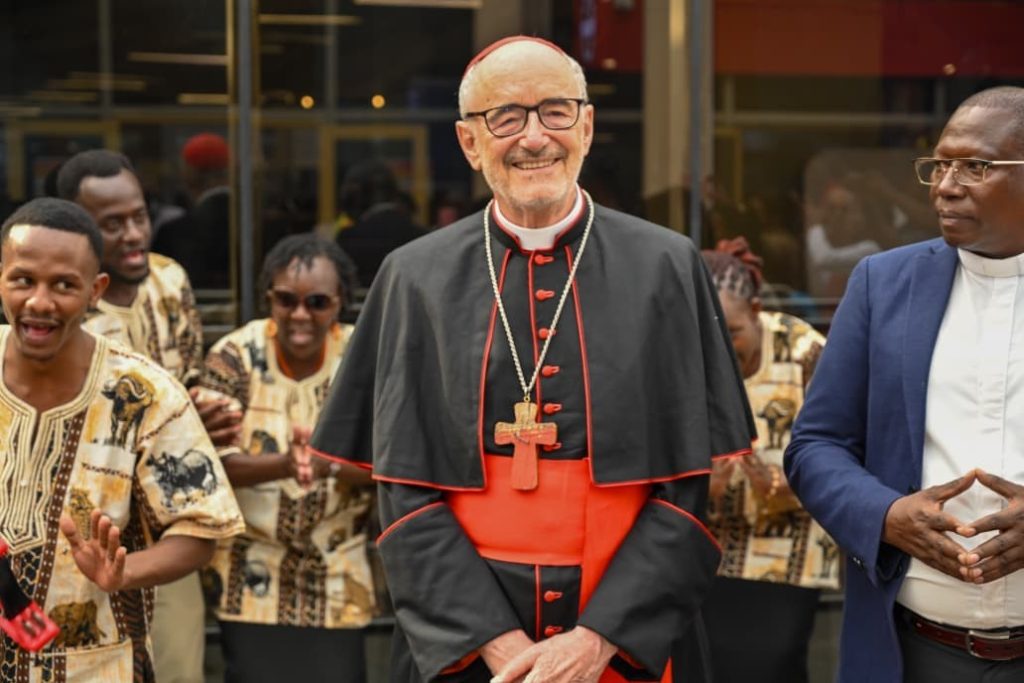
Cardinal Michael Czerny, S.J., in Nairobi, Kenya, for the 21st Plenary Assembly of AMECEA (Association of Member Episcopal Conferences in Eastern Africa), held at the Catholic University of Eastern Africa, 19–26 July.
The Laudato Si’ Action Platform congratulates Cardinal Michael Czerny, S.J., on a recognition of leadership that has consistently brought care for creation into the wider work of human dignity, social justice and integral human development.
Cardinal Michael Czerny, S.J., Prefect of the Dicastery for Promoting Integral Human Development, 2022–2026, has been named the inaugural recipient of the Pope Leo XIV Sustainability Medal, a new international distinction established by Villanova University in 2026.
The medal recognizes leadership at the intersection of sustainability, ethics and integral human development. Rather than considering sustainability only through environmental or technical measures, Villanova describes the award as recognizing a more holistic approach: one that brings together care for the environment, social justice, concern for vulnerable communities, and responsible stewardship of economic and natural resources. The medal will be awarded every two years in connection with Villanova’s International Sustainability Conference.
Cardinal Czerny is its first laureate, recognized for a ministry spanning social justice, human rights, migration, refugees, care for creation and integral human development. Pope Leo XIV will personally present the medal on October 13 at Borgo Laudato Si’ in Castel Gandolfo, during Villanova University’s 2026 International Sustainability Conference, Responding to the Cries of the Earth and the Poor.
For the Laudato Si’ Action Platform, his selection carries particular meaning.
A wider horizon for care of our common home
The Platform exists to help Catholic institutions, communities, families and individuals discern how Laudato Si’ can become part of the way they live: through reflection, planning and concrete action.
But integral ecology continually asks us to look beyond any individual action. Environmental degradation intersects with poverty and displacement. Decisions about consumption and energy have consequences for people and places. The health of communities cannot ultimately be separated from the health of the ecosystems on which they depend.
Throughout his leadership in the Dicastery for Promoting Integral Human Development since 2021, Cardinal Czerny has helped keep this wider horizon visible.
That accompaniment has included his encouragement of initiatives such as Laudato Si’ Week, the Laudato Si’ Action Platform and the Season of Creation, each offering different ways for communities around the world to encounter Laudato Si’, deepen ecological conversion and translate it into action.
His wider ministry has also continually placed those efforts alongside the Church’s concern for migration, poverty, conflict, human rights and the dignity of communities facing social and environmental vulnerability.
For those of us who serve the Platform, that perspective is an important one: our work for care of our common home does not stand apart from the rest of the Church’s mission. It belongs within the larger pursuit of integral human development.
“What kind of a world are we building?”
In responding to the announcement, Cardinal Czerny turned attention away from the honor itself and toward what the medal asks of others.
“What’s most important, I think, is the commitment that the university is making to include sustainability in how it is forming the future leaders of our Church.”
He described sustainability as a question larger than the environment alone. It is one that is social and increasingly technological as well. At its heart, he said, is a question about our shared future: “What kind of a world are we building?”
His response points toward responsibility rather than recognition. The world of the future, he stressed, is not simply something that happens around us. We participate in creating it.
That conviction is also at the heart of the Laudato Si’ Action Platform. Ecological conversion becomes concrete when people and institutions recognize that their choices matter, discern the responsibilities particular to their circumstances, and act together.
From formation to action
Villanova University says its own sustainability commitments include participation in the Laudato Si’ Action Platform and the development of a Laudato Si’ Plan.
Cardinal Czerny’s emphasis on the formation of future leaders therefore speaks to something that reaches well beyond a single award or institution. Lasting ecological change requires not only better technologies or policies, but people and communities formed to recognize responsibility for one another and for our common home.
That kind of formation happens in universities. It happens in parishes, dioceses and religious communities. It happens in families. And it happens whenever reflection begins to shape the choices we make together.
The inaugural Pope Leo XIV Sustainability Medal recognizes a lifetime of leadership in that wider vision.
Cardinal Czerny, congratulations on this recognition. From all of us at the Laudato Si’ Action Platform, thank you for your guidance, encouragement and stewardship, and for helping keep before us the larger horizon to which care for our common home belongs.
Featured photograph property of the Dicastery for Promoting Integral Human Development.