In Belén de los Andaquíes, a small town in the department of Caquetá known as the “Green Water-Protecting Municipality,” the Catholic faith and care for creation are becoming deeply rooted in the land.
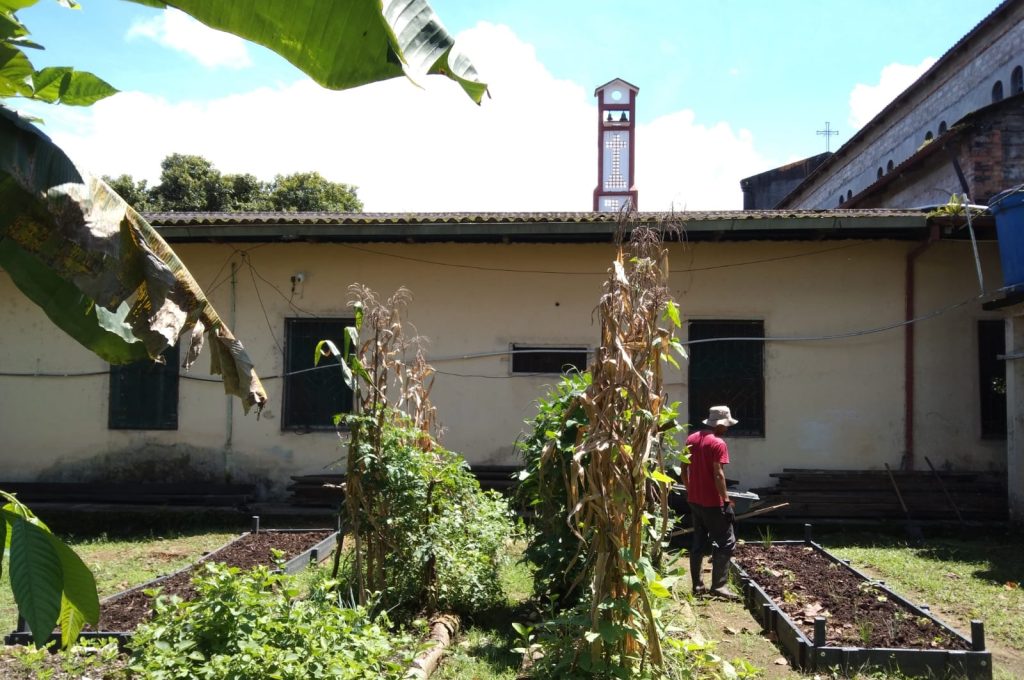
At the Sacred Heart of Jesus Parish, located in the Andean-Amazonian foothills of Colombia, a group of laypeople, catechists, and their parish priest have transformed the green space around the rectory into an ecological orchard that has now become a place of prayer, learning, and ecological conversion.
For John Elvis Carrillo López, a Laudato Si’ Animator and one of the project’s driving forces, this commitment stems from a deep conviction.
“We live in ‘Paradise,’” he affirms. “God did not leave us this land to enrich ourselves, but to preserve and conserve it for the coming of our Lord Jesus Christ.”
A Land of Blessings
Belén de los Andaquíes is a privileged place. Surrounded by rivers, forests, wetlands, and extraordinary biodiversity, the municipality is home to nine municipal natural parks and one national park. It is a territory where the Amazon rainforest still pulses with life.
However, this natural wealth faces serious threats.
“Deforestation due to extensive cattle ranching, low agricultural food production, illicit crops, and armed conflict are challenges affecting our territory,” explains Carrillo.
Even so, the community keeps hope alive.
“Despite all these circumstances, the community of Belén has never lost its faith.”
That hope is deeply rooted in the spiritual history of the municipality, founded in 1917 by the Capuchin friar Jacinto María de Quito. Since then, generations of missionaries have accompanied this community, sowing a faith that today inspires a new form of evangelization.
From Training to Action
The idea of becoming an EcoParish emerged during the training of Laudato Si’ Animators, a program of the Laudato Si’ Movement that offers personal formation to Catholics around the world to deepen their understanding of the encyclical Laudato Si’ and discern how to put integral ecology into practice in their daily lives and communities. As a partner of the Laudato Si’ Action Platform, the movement helps inspire and prepare people committed to caring for our common home.
“Thanks to the training, we were able to reflect on ecological conversion and recognize the great environmental, cultural, and infrastructural treasures we possess,” recalls Carrillo.
The parish already had a key element: a large plot of land surrounding the rectory and a pastor willing to work with his own hands.
Father Ferney Rayo Maceto, born to a family of farmers, had begun organizing the space through cleaning and planting. When the team presented the proposal to him, his response was immediate.
“He agreed to support this magnificent idea.”
Like so many faith-inspired initiatives, the project began with prayer.
“We placed the project in God’s hands,” says Carrillo, quoting Psalm 127: “If Yahweh does not build a house in vain do its builders toil.”
An orchard built with their own hands
What began as a vision is now a concrete reality.
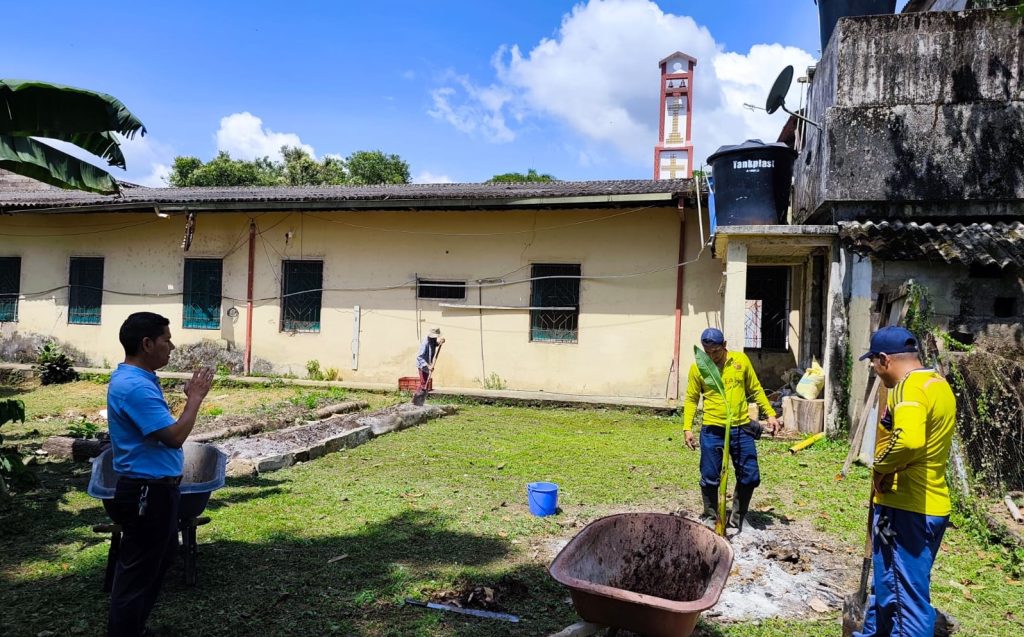
On the grounds of the rectory, the team has established four growing areas for corn, medicinal plants, and vegetables. They have also set up an area to produce organic fertilizer and compost tea.
“To date, and by the grace of God, we have four cultivated fields,” Carrillo shares.
There were no large budgets or external funding.
“The resources have been provided by God’s Divine Providence.”
The work has been carried out with simplicity and perseverance.
“We have worked with great love, with our own hands.”
Every plant sown is, for them, an act of faith. Every seed represents the certainty that the Gospel can take root in the earth and bear fruit.
Learning from One Another
The process has also strengthened community life.
“It has been very rewarding,” says Carrillo. “We have learned from one another, sharing our knowledge and experiences.”
The team consists of José Aníbal Martínez Rodríguez, a candidate for the permanent diaconate; Rafael Calderón Cuenca; and John Elvis Carrillo López, all of whom are committed to catechesis and theological formation.
Carrillo sums up the experience with the words of St. Paul: “There are different kinds of gifts, but the same Spirit.”
Each member brings something different, but they all share the same mission: to help the community rediscover its responsibility as stewards of creation.
A Living Classroom for Children and Youth
One of the most beautiful fruits of the project has been the integration of the garden into catechesis.
Children and youth preparing for First Communion and Confirmation actively participate in the space, observing the plants, recognizing aromas and flavors, and learning to value nature.
“We have put the Gospel into practice by interacting with the garden,” explains Carrillo.
The experience also teaches them about healthy eating and food security.
“We reflect on the importance of a healthy and balanced diet based on the region’s local foods.”
But the teaching goes beyond the practical.
“We have realized the importance of valuing and caring for the environment, raising awareness about the importance of sowing and cultivating, while God does the rest.”
Carrillo acknowledges that the fruits are not always immediate.
“We may not see the fruits of the catechesis now, but we know we have planted that seed in their hearts.”
The leadership of a pastor who leads by example
Father Ferney has been a key figure in this process.
More than just supporting the project, he has embodied it through his own witness.
“He has been organizing the place with his own hands, beautifying, planting, and cleaning.”
His gardens and the ecological orchard reflect a simple yet powerful conviction: care for our common home begins at home.
“The parish priest is a living witness to us,” says Carrillo. “To care for the environment, you have to start at home.”
His leadership has inspired the parish’s apostolic groups and families to adopt more sustainable practices and to view ecology as an integral part of the faith.
Evangelizing from the Amazon
For the Sacred Heart of Jesus community, integral ecology is not an additional activity. It is a concrete dimension of evangelization.
“We are directly responsible for the impacts on the planet, but we are also the main agents of change and solutions.”
Through the garden, catechesis, homilies, and daily life, the parish seeks to proclaim that everything is connected: faith, the earth, social justice, and the future of the next generations.
A vision for the next seven years
The community envisions that, within seven years, their EcoParish will be a model of ecological conversion for other parishes in the region.
“Our EcoParish will be a model for other communities.”
Their message to other parishes is as simple as it is hopeful.
“You shouldn’t worry about resources and funding, but rather have faith, love, and hope.”
For them, what matters most is not having vast resources, but the willingness to begin.
“It is by working with love that our proposed goals come to fruition.”
In Belén de los Andaquíes, where the Amazon rainforest embraces the town and faith continues to set the rhythm of daily life, a community is demonstrating that ecological conversion can begin with something as humble as a seed.
And as Carrillo recalls, quoting the Gospel of St. John: “I am the vine, you are the branches. Whoever remains in me, with me in him, bears fruit in plenty.”
In this parish in southern Colombia, that fruit is already growing.