In conversations about climate, inequality, and sustainable development, the future is often framed in terms of risk: projections, probabilities, and scenarios. But many of the challenges societies face today go beyond calculable risk.
They involve something deeper: radical uncertainty.
When societies face deep uncertainty—as they do in the ecological crisis—technical solutions alone are not enough. What sustains long-term transformation is hope: the willingness to continue working toward change even when the outcome is not guaranteed.
Many Laudato Si’ Action Platform participants are working toward ecological and social change in contexts marked by profound uncertainty. Recognizing this, we wanted to listen to conversations about faith, hope, and sustainability that are taking place beyond the Catholic Church and in dialogue with it.
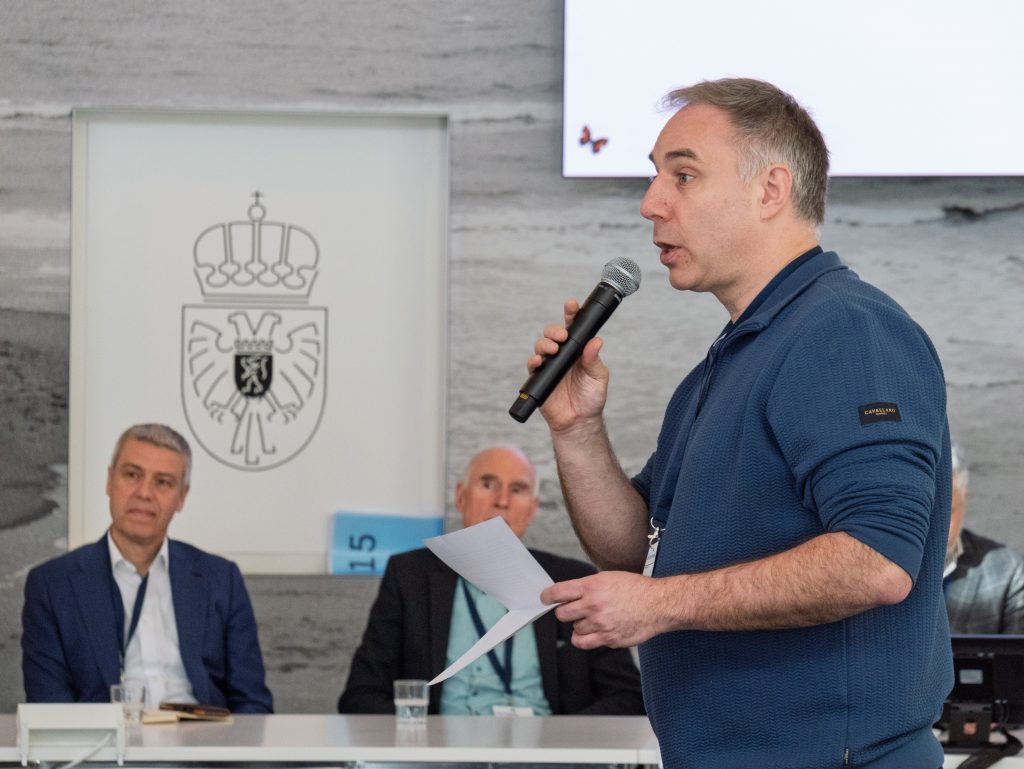
In this conversation, theologian and economist Dr. Jan Jorrit Hasselaar of Vrije Universiteit Amsterdam reflects on how hope can help sustain societies facing uncertainty, what the biblical story of Exodus can teach about long journeys of transformation, and why collaboration across disciplines is essential for meaningful change.
Hope Beyond Optimism
“In the midst of all the noise in politics, economics, and media today, it almost feels miraculous that in 2015 the countries of the world agreed on the Sustainable Development Goals (SGFs),” Hasselaar says.
The SDGs represent a shared global commitment to addressing major challenges such as climate change, water scarcity, poverty, inequality, and unsustainable patterns of production and consumption. Yet these challenges have something important in common: they unfold in conditions of uncertainty.
While risk can be calculated, uncertainty describes situations where the future cannot be predicted with confidence. For Hasselaar, this distinction raises a deeper question: how should societies respond when the path forward is unclear?
Too often, responses fall into two extremes: optimism that assumes solutions will emerge easily, or pessimism that assumes the challenges are too great to overcome. Hope offers a different path. In this perspective, hope is not naïve confidence about the future. Instead, it is a responsible way of acting amid uncertainty, sustaining commitment even when outcomes remain unclear.
What the Exodus Story Teaches About Transition
One biblical narrative that sheds light on this understanding of hope is the story of Exodus. The Exodus is often remembered as a dramatic moment of liberation. Yet the story also includes a long journey through the wilderness: a period marked by uncertainty, setbacks, and gradual learning.
For Hasselaar, this part of the narrative speaks powerfully to the kinds of transitions societies face today. “Hope is not about quick fixes,” he explains. “It is a journey of small steps.”
Ecological and social transformations rarely happen overnight. They involve competing interests, unexpected obstacles, and the need for sustained cooperation over time. In such circumstances, hope becomes essential—not as wishful thinking, but as a way of nurturing trust, solidarity, and perseverance along the journey.
Hasselaar also points to the biblical tradition and importance of shared rhythms of rest and reflection. Practices such as a public Sabbath remind communities to pause, reorient their priorities, and renew relationships with God, with one another, and with creation.
These rhythms can offer valuable insights for institutions and organizations navigating complex transitions today.
Doing Theology in Public
A central dimension of Hasselaar’s work is what he describes as public theology: theology practiced in dialogue with society, science, and public life. Rather than beginning with theological answers, this approach starts with the realities people face.
“We begin with the human condition and the condition of the world,” Hasselaar explains, including the natural world and the ecological crises that affect it.
By listening carefully to the questions emerging from society, economics, and environmental challenges, deeper ethical and spiritual questions often come into view.
This approach resonates strongly with the vision articulated in Gaudium et Spes, the Second Vatican Council’s pastoral constitution on the Church in the modern world. The document affirms that the hopes and anxieties of humanity—especially those of the poor and vulnerable—are also the hopes and anxieties of the followers of Christ.
At the Amsterdam Centre for Religion and Sustainable Development, this collaboration takes concrete form through the research program Hope-Driven Transition.
The initiative brings together scholars from theology, economics, psychology, anthropology, design science, and organizational studies. Equally important, the work involves partnerships with civil society organizations and practitioners working in real-world contexts.
“Only together,” Hasselaar says, “can we make hope tangible in the lives of people and communities.”
A Long Path of Renewal
Environmental debates today often include apocalyptic narratives about the future. The scale of ecological crises can make it seem as though the future itself is slipping away. Yet the language of hope invites another way of understanding transformation.
Seen through this lens, ecological and social change becomes a journey rather than a single breakthrough. This insight resonates strongly with Pope Francis’ encyclical Laudato Si’, which describes ecological conversion as a “long path of renewal.”
Designing such a path requires patience, creativity, and collaboration. No single discipline or institution can accomplish this alone. Instead, meaningful transitions emerge through cooperation—between scientific fields, between faith communities and policymakers, and between researchers and the communities most affected by environmental and social challenges.
Hope, in this sense, becomes a shared narrative guiding collective action.
Listening for Voices of Hope
As the season of Lent invites reflection, discernment, and attentiveness to limits, it also offers an opportunity to rediscover the deeper meaning of hope. Lent encourages slowing down, making space for reflection, and preparing for Easter: the Christian celebration of hope.
One figure often associated with ecological spirituality is St. Francis of Assisi, whose life of simplicity, peace, and care for creation continues to inspire environmental reflection today. His example also shaped Pope Francis’ vision in Laudato Si’, which calls humanity to renew its relationship with creation and with one another.
Hasselaar and his colleagues are developing an initiative called Voices of Hope, an open-access project that gathers reflections from a wide range of voices—including scientists, faith leaders, youth, activists, and artists.
The aim is not to define hope in a single way, but to create a shared space where diverse perspectives can contribute to a deeper conversation about how hope takes shape in practice.
As Lent unfolds, Hasselaar offers a simple but challenging question: Where do we hear voices of hope today—and how might they guide us in caring for our common home?
Hasselaar serves as associate professor of public theology and director of the Amsterdam Centre for Religion & Sustainable Development at Vrije Universiteit Amsterdam. Jan Jorrit is co-chair of the Global Network for Public Theology. He is a research fellow at the University of the Free State in South Africa. From 2011 to 2018, he chaired the working group on Sustainable Development of the Council of Churches in the Netherlands. His work focuses on how theology, economics, and other disciplines can collaborate in addressing the ecological and social challenges of our time.