We’re pleased to feature Brett Beasley of the University of Notre Dame’s Sheedy Family Program in Economy, Enterprise, and Society, where he cultivates moral imagination in emerging leaders. He designs courses that help people clarify and live their values and writes widely on ethics, communication, and influence.
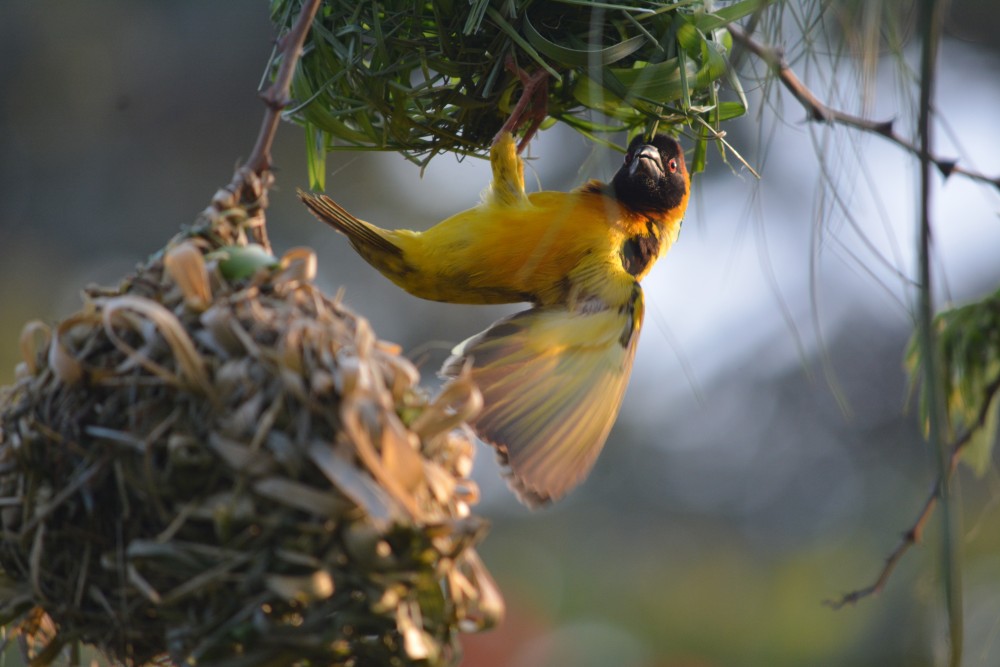
A weaver bird builds its nest on the grounds of the Bethany Land Institute.
I’ll never forget my first “blessing of the animals” service. It was the feast day of St. Francis of Assisi a few years before Laudato Si’ appeared. A few blocks from my downtown Chicago office, I stepped into a grand, gothic-style church only to find its usually serene and stately narthex bustling with noise and movement, more like a busy veterinary waiting room than a sacred space. Owners with pets of all shapes, sizes, and species stood milling about or lining up to process inside.
During the service, leashes shook and carriers jangled during prayers. Barks and meows echoed through the nave of the church between hymns. But what was most surprising was the feeling that something was so fitting about it all—that even though it was a rare thing to invite animals in, they always belonged there, somehow. As the priest knelt down to bless a small schnauzer, I remember feeling in a new way that these creatures were God’s too, and they were just as much in need of God’s blessing as we furless, featherless, scaleless animals who more commonly populate the pews.
The Vocabulary of Creation in Laudato Si’
Just as animals are mainly absent from churches, so too have they been absent from most areas of theology—at least until recently. As theologians Celia Deane Drummond, who today directs the Laudato Si’ Research Institute, and John Berkman remarked in 2014, “as recently as five years ago giving significant theological thought to non-human animals was widely dismissed if not ridiculed in the world of Catholic theology, systematic and moral theology included.”
Laudato Si’ takes a meaningful step toward a deeper reverence for all living beings. Drawing inspiration from St. Francis’s well-known “Canticle of Creatures,” the encyclical emphasizes our kinship with all of creation. While affirming the unique dignity of human beings, Pope Francis also makes clear that this does not grant unchecked dominion over other creatures. He writes, “Each organism, as a creature of God, is good and admirable in itself” and states that animals and their ecosystems “have an intrinsic value independent of their usefulness” (140).
At the same time, the encyclical articulates this vision using broad and evocative language. Consider, for example, that it uses some form of the word “creature” 80 times. But it uses “animal” only 13 times. And about half of those times, it refers to “plants and animals” or a similar grouping. Laudato Si’ does not attempt to outline a taxonomy of ethical responsibilities toward different species. Rather, it invites a contemplative and respectful stance toward all creatures, great and small, and encourages further discernment on how this outlook may inform specific actions in various contexts.
Eating with Care: Animals, Agriculture, and the Call of Laudato Si’
This issue matters—and not just for ethicists and other professional scholars. It matters for many of our everyday decisions, including decisions about what to eat. After all, the human demand for animal products, including meat and dairy products, has been a major force in reshaping our world.
The 2019 Global Assessment Report by the Intergovernmental Science-Policy Platform on Biodiversity and Ecosystem Services (a U.N.-backed biodiversity panel) found that humans and our domesticated animals now constitute the vast majority of mammalian biomass on Earth. According to the IPBES assessment, wild mammals biomass has fallen by 82% percent.
The main aim of a papal encyclical is not to offer specific advice. Rather, it is to identify the orientation toward a problem. As Pope Francis notes at one point in Laudato Si’, “On many concrete questions, the Church has no reason to offer a definitive opinion; she knows that honest debate must be encouraged among experts, while respecting divergent views” (61).
The encyclical’s limited treatment of animal agriculture may also be understood in light of what Pope Francis describes as “differentiated responsibilities” (170). In Laudato Si’, he notes that groups and individuals with greater influence and resources should expect to take a larger role in addressing ecological issues. Thus, when Pope Francis did make a comment that “it would be appropriate to consume less meat,” he made it clear that this advice applied primarily to “certain areas of the world”—presumably the most wealthy and stable ones.
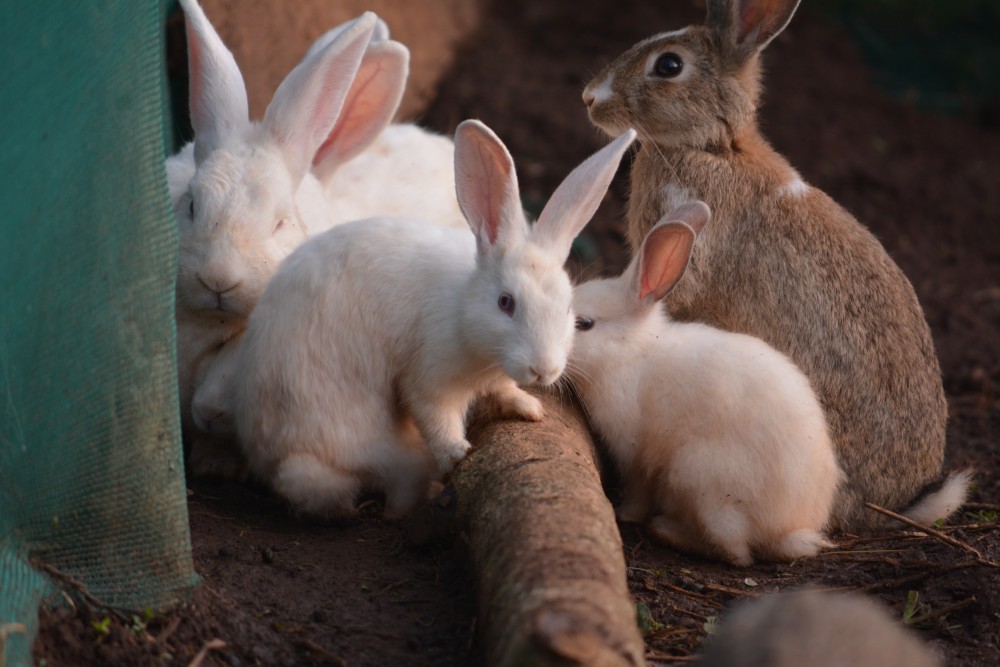
A group of rabbits at the Bethany Land Institute
Caring for Animals, Cultivating Connection
Nevertheless, although Laudato Si’ does not offer specifics about animal agriculture, we should not conclude it has nothing substantive to say about the matter.
First, and most importantly, Laudato Si’ defines human nature in such a way as to make care for other creatures central to what it means to be a human being. The human distinctiveness from other creatures is an invitation to cultivate, not dominate.
Laudato Si’ expresses the need for new models and organizations. One striking example of such a model is the Bethany Land Institute (BLI) in Uganda, which was co-founded by my former professor Fr. Emmanuel Katongole and operates with the aim of putting Laudato Si’ into practice.
This summer, I participated in the Laudato Si’ Africa Conference, which gathered delegates from all over the world on the grounds of BLI. There I walked with farmers-in-training—called “caretakers”—who spoke with joy about their animals: rabbits, ducks, pigs, goats, cows, and more. Each caretaker seemed deeply attuned to the needs and behaviors of the animals in their care, explaining how practices like rotational grazing and natural fertilization connected animal well-being to soil health and the wider regenerative ecosystem.
I remember one caretaker, Thomas, gently scratching the head of a pig named Waldo, a moment that recalled a blessing of the animals, yet felt more enduring. This wasn’t a symbolic act for one day a year, but a way of life—one rooted in connection and care for our non-human kin.
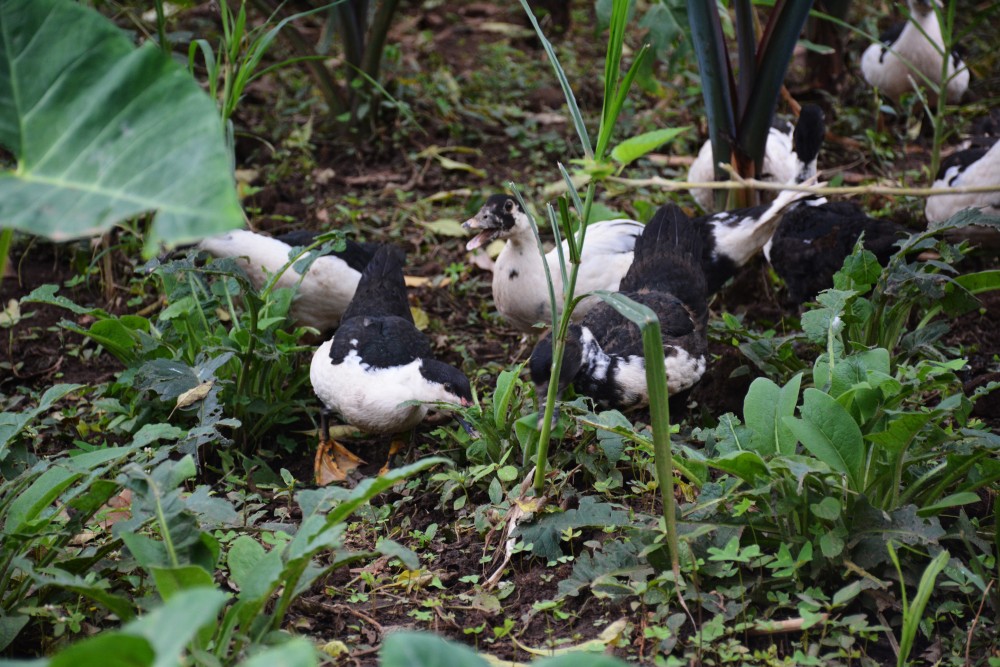
Ducks forage at the Bethany Land Institute.
Conclusion
In Laudato Si’, Pope Francis calls for an “ecological conversion.” That vision includes the creatures with whom we share our lives and landscapes, not as commodities, but as fellow beings within God’s creation. Whether in a cathedral filled with barking and purring companions, or on a farm in Uganda where animals help restore the land, these moments of relationship—of blessing and being blessed—remind us that animals are not outsiders to our moral imagination or spiritual life. They belong. They matter. And so do the everyday decisions that shape how they live and how we live with them.
Call to Action
As we reflect on Brett’s experiences and the vision of Laudato Si’, we are invited to consider how our own choices—what we eat, how we farm, what we bless—can express a more sustainable and compassionate way of life. Explore concrete ways your community or institution can take action.
Live more deeply in harmony with all God’s creatures
Under the goal of Adoption of Sustainable Lifestyles, you’ll find suggestions to help you reduce harm, foster connection, and live more deeply in harmony with all God’s creatures.